

When Is the Right Time to Redecorate Your Home?
There's a version of readiness we imagine will arrive before we make any changes at home — the boxes unpacked, the hard season passed, the routines finally making sense again. Only then, we tell ourselves, will we be ready to begin.
But homes rarely meet us at the neat end of things. They meet us in the middle — after a move, after a separation, after years spent caring for other people, after a change we chose or one we didn't. I've made that particular move more than once myself across different continents and life stages — I know exactly how long "settled" takes to arrive, and how little it has to do with whether your home is allowed to feel like yours.
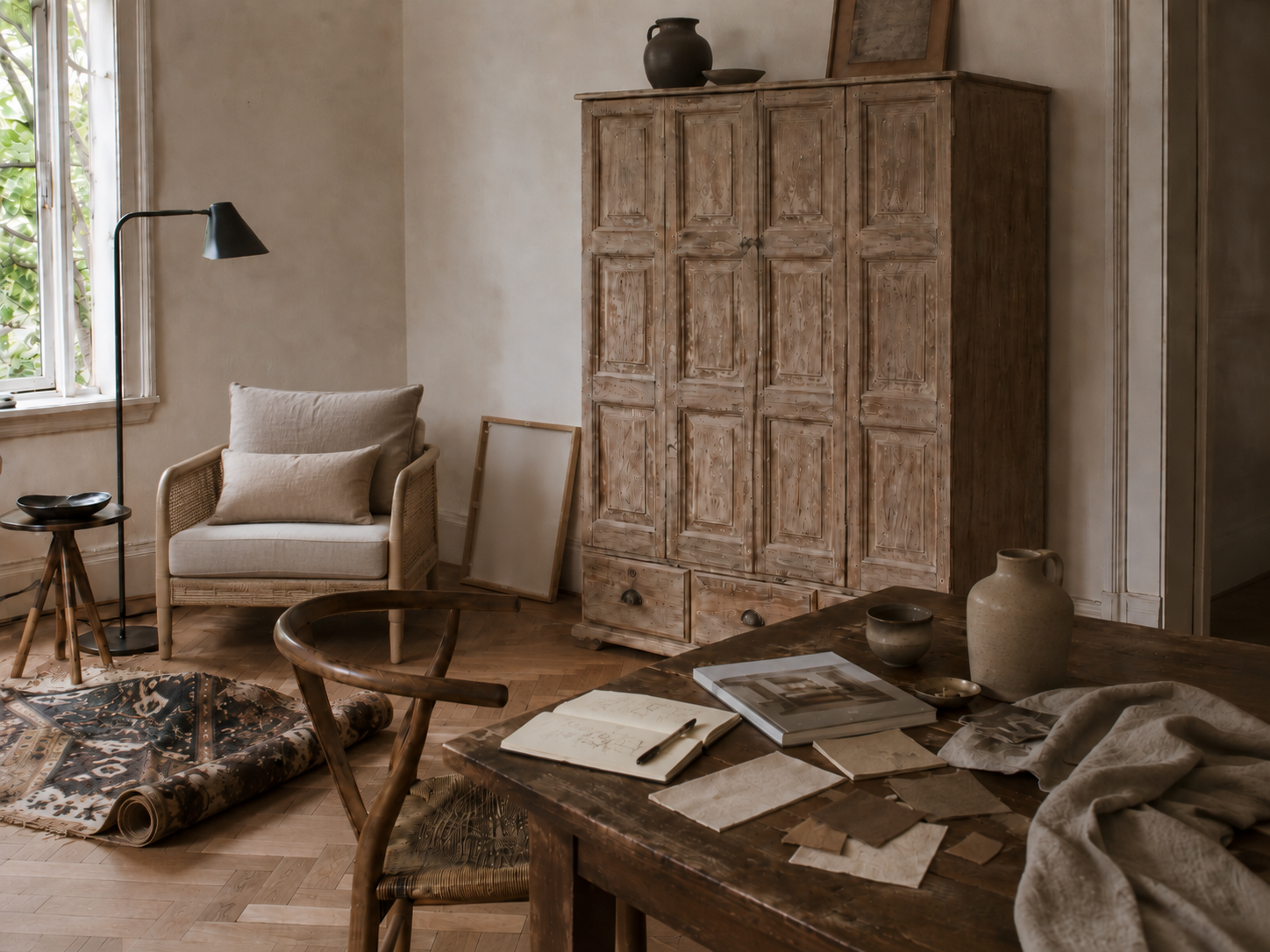
HOMES MEET US IN THE MIDDLE
One corner, caught mid-thought — nothing here is finished, and nothing needs to be yet.
You don't have to solve the whole house in one breath
Most people delay because they can't see the complete answer. They know the living room feels wrong but can't picture what the whole house should look like. They want more warmth but can't quite name their style. They know certain pieces don't belong anymore but aren't sure what should replace them.
That uncertainty makes every choice feel more permanent than it is. A sofa starts to feel like a decision about the next decade. A paint colour ends up carrying the weight of the entire house. You don't need that pressure — and you don't need to solve for all of it at once.
We can begin with one room. Sometimes even one corner is enough to test the direction of the whole home, reveal which pieces still belong, and show you what kind of atmosphere feels right now.
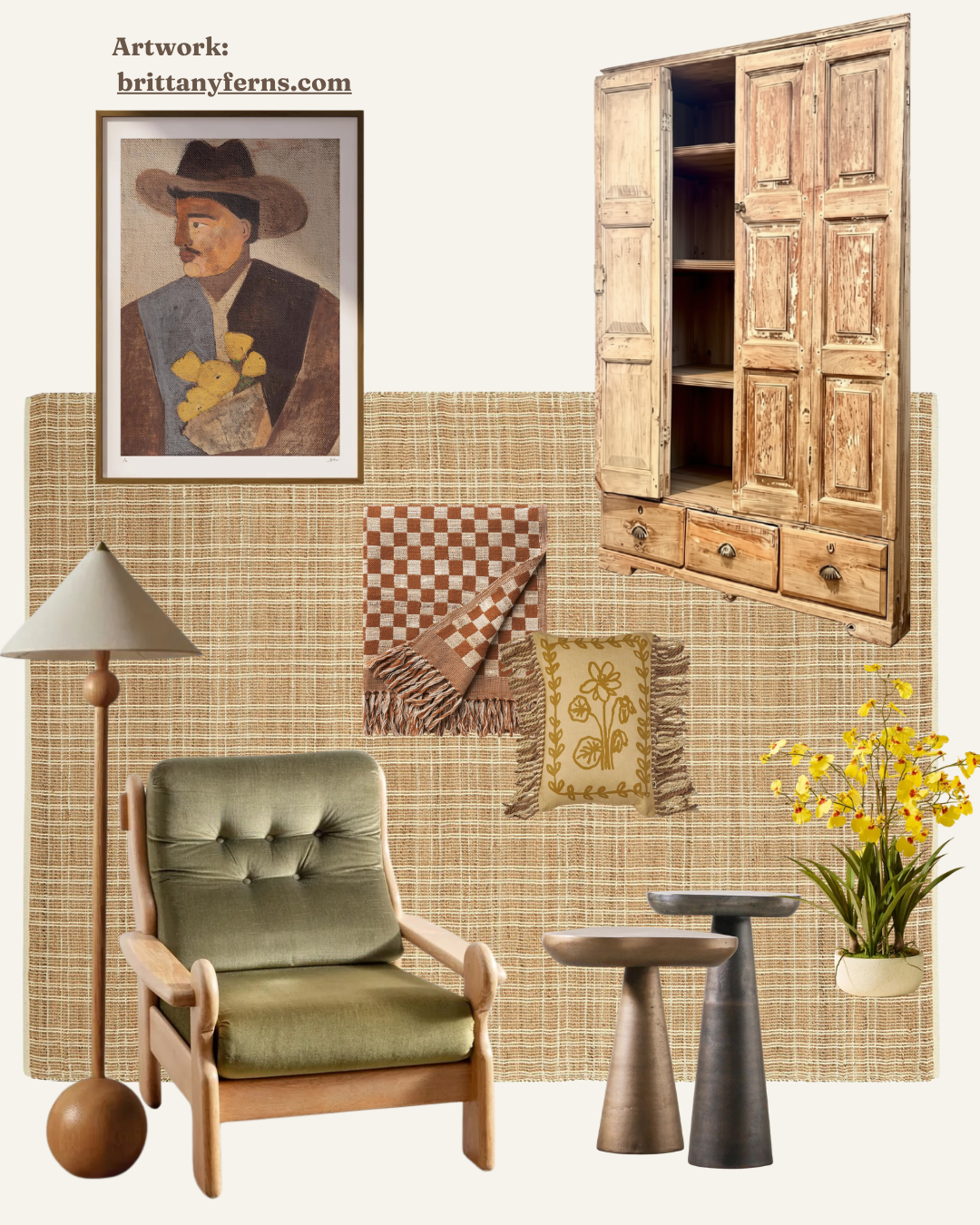
ONE ROOM (OR CORNER), FULLY REIMAGINED: One Vintage Teak Dowry Cabinet, and everything else chosen to answer to it. Art credit: Man at the Flower Market by Brittany Ferns.
Other Sources:
Robbi Floor Lamp - McMullin
1970s Brutalist Oak Lounge Chair in velvet and oak - Tigmi Trading
Aurel Side Tables in Black Brass + Antique Brass - Few & Far
Plaid Sandstone Rug - Darren Palmer x Unitex
Equally, if a whole-home plan turns out to be the clearer path, that's fine too — the two aren't in competition. The point isn't to guess the right scope on your own before you start. It's to diagnose it properly, so a single room doesn't get pushed into a bigger project before you're ready, and a connected problem doesn't get chased with a trail of unrelated purchases instead.
Look for the resistance
Readiness rarely arrives as a grand realisation. More often, it shows up as resistance: the same furniture, shifted around again without result. Smaller decorative pieces bought in the hope that one of them finally pulls the room together. Hesitating to invite people over because the main room never quite feels comfortable. A space you avoid without being able to say exactly why.
Sometimes the resistance is about routine, not taste. The formal dining room barely gets used, but there's nowhere comfortable to work. The spare room has become a holding pen for decisions you haven't made yet. The living room is still arranged around a way of spending time that doesn't suit the household anymore.
None of that means you've failed to maintain the home properly. It means the relationship between your surroundings and your daily life has shifted — and the room is telling you so.
Changing a room doesn't mean erasing its history
There's a real hesitation around changing a home that holds shared purchases, inherited furniture, family photographs, travel pieces, or objects connected to someone who isn't there anymore. Keeping everything exactly as it is can feel respectful. Moving anything can feel loaded.
But design doesn't have to divide a room into what must stay and what must go. It can start with interpretation instead. An inherited cabinet might remain, but move to a room where it's finally properly seen. A much-loved object might need space around it rather than twenty others crowding it. A familiar chair might still belong — just with new upholstery and a better place to sit.
The aim isn't to make the home forget. It's to let memory remain without asking every room to stay frozen around it.
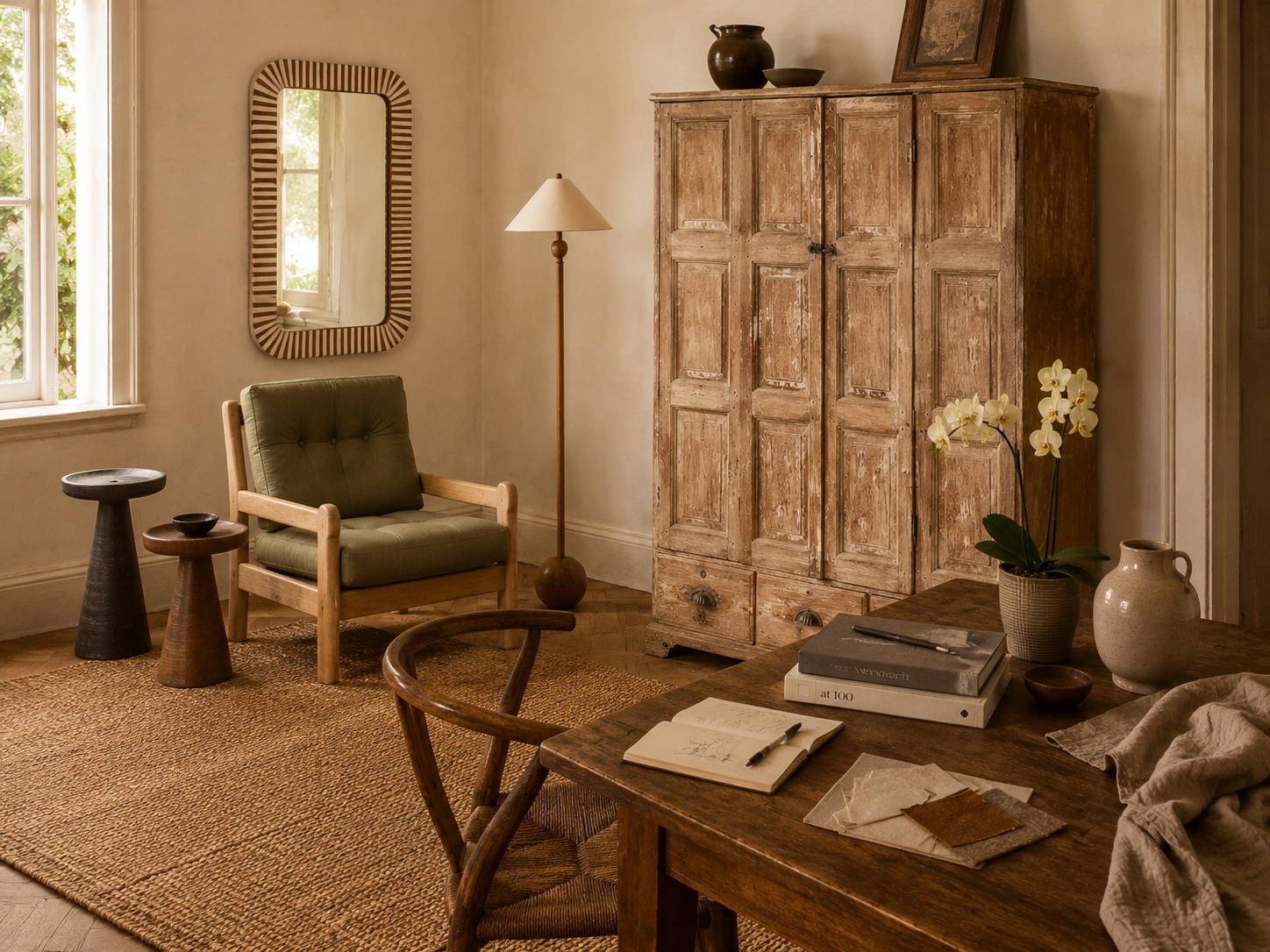
STORIED + NEW: A meaningful piece with patina is the anchor for this room placed within a fresh and layered setting.
The vintage cabinet gets a new life with modern relevance beside a contemporary lamp, bone inlay mirror, and earthy, elegant pair of artisan-crafted side tables.
Begin with the room asking the most of you
If several rooms feel unfinished, start with the one creating the most practical or emotional drag — not necessarily the most visible one, or the one guests see first, but the one you have to work around every single day.
It might be the bedroom that never feels restful, the living room where nobody quite knows where to sit, the entry that turns every arrival into a search for somewhere to put things down. Ask what that room is currently asking of you — an awkward layout you keep working around, storage you don't have, lighting that makes evenings feel harsh — then ask what would make it more supportive. Not impressive. Not finished forever. Just supportive.
That's enough of a brief to begin.
You don't need to name your style first
People often postpone redecorating because they can't describe their style with confidence. But a style label isn't always the most useful starting point.
You might not know whether your home is collected, contemporary, coastal, global, or something else entirely — and those words are more useful later than they are now. It's often more helpful to notice what you consistently respond to: natural materials that show their age, colour that feels sun-washed rather than sharp, furniture that invites people to stay, objects with a story and some evidence of a human hand. You can just as easily start by naming what you no longer want to feel — crowded, temporary, formal, disconnected, stuck.
A room can feel more like you well before you've found the perfect name for it.
Your home can meet you where you are
There's no prize for waiting until every part of life feels settled. Often, a stronger sense of belonging starts with ordinary decisions — a lamp that changes the room at dusk, a chair placed where you actually want to sit, a table finally cleared of things that accumulated without intention, a piece of art hung instead of leaned against the wall waiting for the right moment.
None of these decisions has to explain your whole life. They just need to make daily life feel a little better supported.
That might be the most honest answer to the question of when the right time is: not when every uncertainty has disappeared, but when the home you have is asking for a more useful, more personal response to the life you're living now.
We can begin with one room. The whole house doesn't have to be solved in one breath.

MEMORY, REIMAGINED: A vintage cabinet reimagined as a coffee station in the kitchen. Here it adds soul and story to an otherwise new kitchen, This dedicated home coffee station turns a chaotic morning scramble into a mindful daily ritual.. The cabinet’s weathered timber doesn’t read as old and imperfect. Instead, it instils character, gives a sense of renewed energy and revival, and becomes the piece that grounds the space.
Frequently asked questions
How do I know if I'm ready to redecorate my home? You don't need a defined style, a full plan, or total clarity on what's changed. Readiness usually shows up as resistance — avoiding a room, moving the same furniture around without result, a space that no longer supports how you actually live. That's enough of a signal to start. The Align + Define Call is a free, no-pressure way to talk it through first.
Do I need to know my design style before working with a designer? No. Most clients arrive without a name for their style — just a sense of what they respond to and what they want to stop feeling. Naming the style tends to emerge through the process, not before it.
Can I redecorate just one room, or do I have to commit to the whole home? One room is a complete starting point. The Passport Plan is built for exactly that — one room, fully reimagined, from $895, delivered in 14–21 days. If it turns out the same lack of direction runs through more spaces, that's a conversation for later, not something you need to decide upfront.
How long does redecorating one room take? Through The Passport Plan, a single room typically takes 14–21 days from your kickoff call, including a mood board, one revision, and a sourced list of up to 15 items. Multi-room work through The Atlas Experience or a full-scope Grand Tour runs longer and is scoped individually.
What if I want to keep sentimental or inherited pieces? They're usually the starting point, not the obstacle. An inherited piece can move to a room where it's properly seen, get reupholstered, or simply be given space instead of being crowded — it doesn't have to freeze the whole room around it.
Not sure whether the issue is one room or the whole home?
The Thread Test is free — ten questions, one clear read on what's actually missing, room by room.
I'm based in St Kilda, working in person across Melbourne's inner and bayside suburbs, and through e-design anywhere in Australia.