

Could Your Room Introduce You?
There's a question in The Thread Test I just launched that I keep coming back to:
Does anything in this room have a story attached — or could it all have come from the same catalogue page?
It sounds simple enough, but it becomes surprisingly revealing once you stop answering from memory and actually stand in the room.
A room can be beautifully furnished, thoughtfully arranged and full of things you genuinely like, yet still tell us remarkably little about the person who lives there. The pieces may all be attractive. They may even work together. But if nothing in the room hints at where you've been, what you value, what you've kept or what you'd never willingly part with, then something important may be missing.
So here's another way to ask the question.
If I walked into your living room before I met you, what would I know?
Not whether you like green, or whether you prefer linen to velvet, or whether you've found a particularly good source for lamps. Those things tell me something about your taste, certainly.
But would I know anything about you?

Layered Living Room Refresh: Vintage Pieces, Contemporary Artwork + Varied Materials
A memorable room rarely reveals itself all at once. It leaves clues. The brass monkey tells me this person has a sense of humour and fun.
Artwork Credit: brittanyferns.com
Vintage Primitive Hand Carved Coffee Table by marigoldinteriors.com.au
The best rooms leave clues
There's usually something in a memorable room that makes you want to ask a question.
Where did you find that? Who painted it? Why is that old chair still here? Is that from somewhere you lived?
That curiosity is often the first sign that a room has moved beyond being simply well decorated.
Not because every object needs extraordinary backstory. Most of them won't, and frankly, that would be exhausting. What matters is that at least some of the things around you have a reason for being there beyond the fact that they suited the palette.
One of mine is a hand-blown glass carafe and tumbler set I bought in Spain, packed for Costa Rica, and packed again for home — the glass slightly asymmetrical, with tiny air bubbles caught in it, proof someone's hands made it rather than a mould.
You'll recognise the type even in other rooms: a battered little table bought years ago when you had very little money but very definite opinions. A ceramic bowl carried home wrapped rather precariously in a jumper. A stack of books that actually gets read, an inherited piece that would never have survived a strict mood-board edit, something slightly odd that makes complete sense once you know its history.
These are the pieces that give a home specificity. They provide evidence that someone lives here, rather than simply evidence that someone has furnished it.
And that matters.
A room doesn't need a theme. It needs a point of view.
One of the quickest ways to strip personality from a room is to make every choice agree too neatly.
The same timber appears everywhere. Everything belongs to roughly the same era. The colours sit politely within range of one another, and every finish carries the same degree of newness.
On paper, it can sound perfectly sensible.
In reality, the room can become so well behaved that there's nothing for the eye — or the memory — to catch on.
The rooms that stay with us usually have a little tension in them. Something old beside something crisp. A serious antique sitting beneath a completely unserious piece of art. A sculptural chair interrupting an otherwise restrained room. A slightly peculiar object that makes sense because of the person who chose it, not because it matched the sofa.
That tension is useful because it tells us someone has made a decision rather than simply assembled a look.
A personal room is rarely the result of everything coordinating. More often, it's a collection of choices that reveal a consistent point of view, even when the pieces themselves are quite different.
You don't need to explain the story to everyone who walks through the door.
The room simply needs to feel as though there is one.

Vintage Primitive Hand Carved Coffee Table, A Characterful Anchor
The most personal rooms aren't overly coordinated. They're held together by a point of view, aged timber paired with contemporary art.
The catalogue is useful. It just shouldn't write your biography.
There is, of course, nothing wrong with buying new furniture.
Thank goodness, because occasionally we do require a sofa that hasn't survived three share houses and a Labrador.
The trouble starts when every decision comes from the same visual language. You buy the sofa shown with the rug, then notice that the side table looks rather good beside it, so that comes too. The lamp follows, and perhaps the artwork as well, because it conveniently carries exactly the right colours.
None of these choices is individually wrong.
But somewhere along the way, the room can stop being about you and start becoming an excellent representation of somebody else's merchandising department.
Character often arrives when something interrupts that sequence.
A piece you already own. A painting whose colours weren't part of the original "scheme." A table brought back from another country. An inherited chair that needs recovering rather than replacing. An object that has absolutely no idea what this season's interiors are supposed to look like.
Those pieces do something very useful: they stop the room becoming too obedient.
Your possessions don't all need impressive stories
There's a slightly dangerous version of this conversation where suddenly every object is expected to have been discovered in a Marrakech souk after a three-hour conversation with the maker.
That would be quite a lot to ask of a bookshelf.
Meaning doesn't require glamour, and some of the things that give a room the most character are incredibly ordinary.
Your grandmother's mixing bowl might matter more than an expensive decorative object. A framed postcard can hold more emotional weight than a perfectly styled gallery wall. The slightly terrible sculpture your child made at school may never feature in an interiors magazine, but perhaps you would notice immediately if it disappeared.
Then there are the quieter things: a photograph, a chair you bought when you first lived alone, a book you have carried through four house moves, a small object connected to a place or period in your life.
These things work because they belong to your life rather than to an interiors formula.
A room full of "special" objects can feel just as constructed as a room full of catalogue purchases if none of them has any real connection to the person living there.
The aim isn't backstory.
It's recognition.
You should be able to look around the room and recognise yourself somewhere in it.
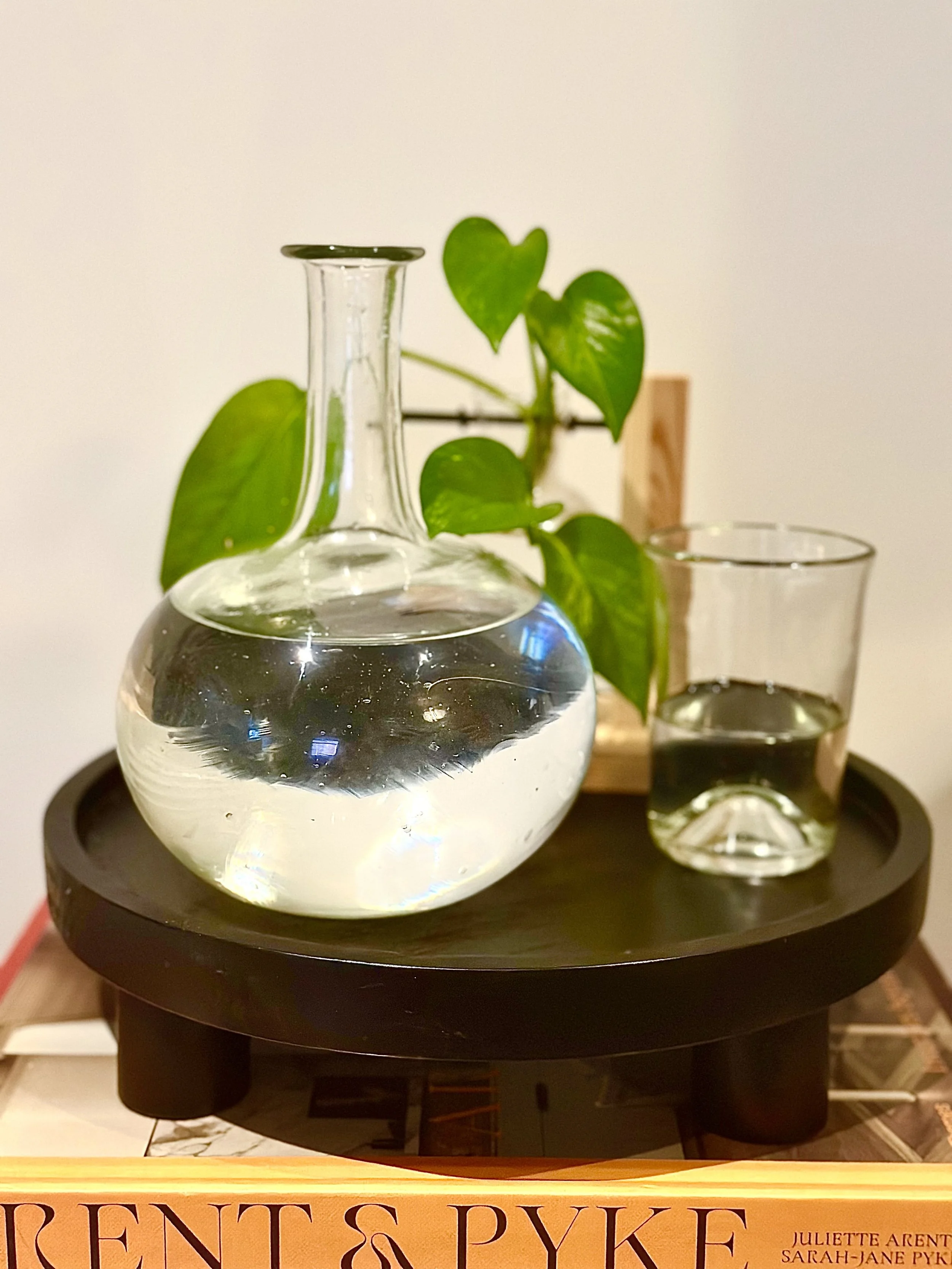
Spanish Hand-Blown Glass
Meaning doesn’t have to be grand. Often it’s the ordinary things that make a room feel most like yours.
This handmade glass carafe and tumbler set accompanied me across Continents and through several major life-changes. I love how the glass carries imperfections and evidence of the hands that made them.
Start with the thing you would defend
Here's a useful exercise.
Look around the room and imagine someone suggesting, one piece at a time, that everything should go.
What do you immediately object to?
That answer is often more revealing than asking what your favourite interior style is.
The thing you would argue for may tell you more about your taste than the ten things you bought because they seemed sensible. Perhaps it's an artwork, a chair, a rug, a sideboard, something inherited or something completely odd that nobody else would have chosen.
Whatever it is, that piece may be the beginning of the room's real identity.
Rather than asking what should be added next, look more closely at what already deserves attention. What colours does it contain? What material is it made from? Does it introduce a shape, a mood or a sense of age that could be answered elsewhere in the room?
Not matched.
Answered.
That's how a thread begins: one decision, followed by another that acknowledges the first.
Once that starts happening, the room becomes less like a collection of separate purchases and more like a conversation.
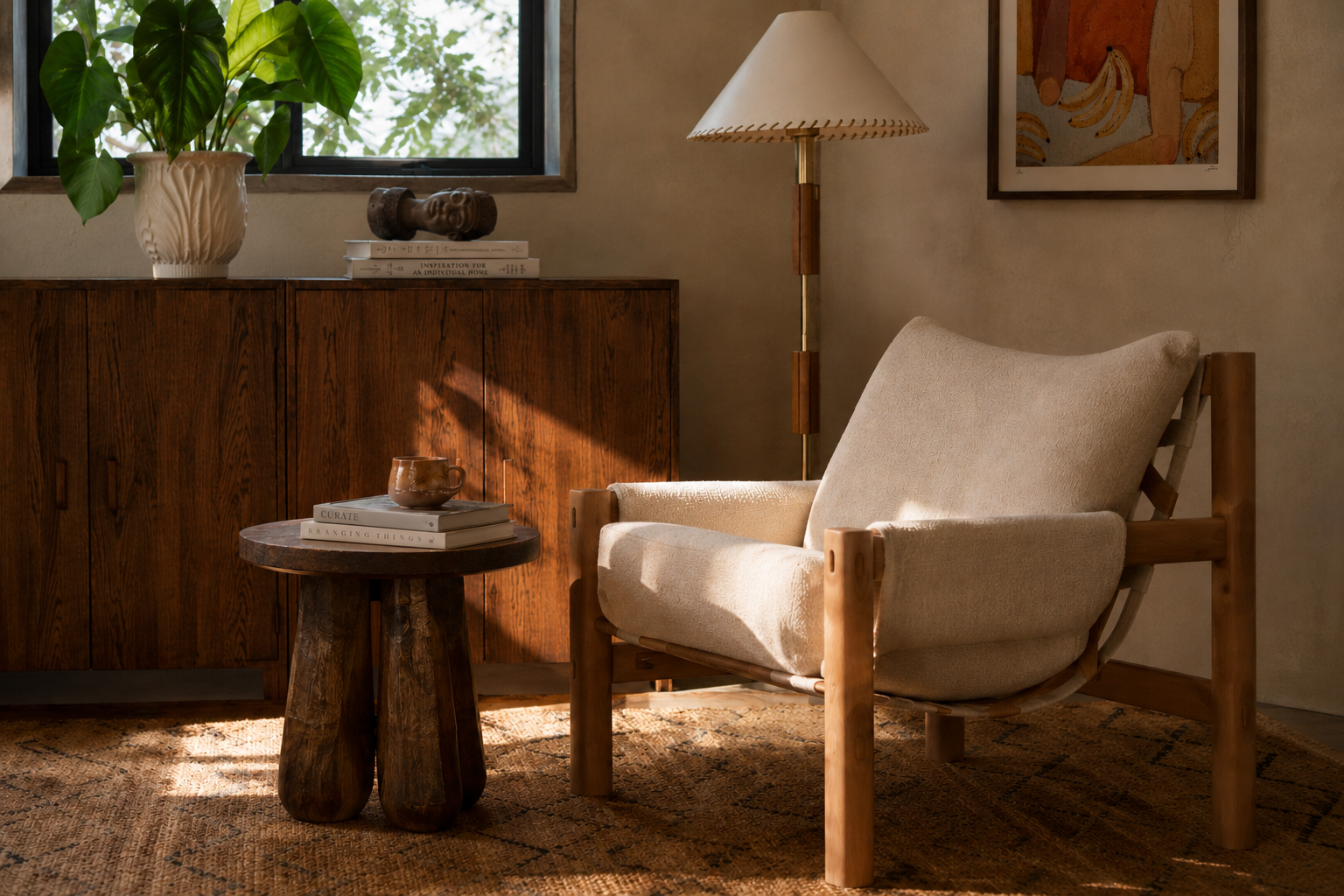
Every good room has something worth defending — a piece that quietly sets the tone for everything around it.
An object with history, the carved stone statue, finds a place to rest in this reading nook.
So — could your room introduce you?
Imagine someone walking through your front door knowing absolutely nothing about you.
Would they see evidence of places you've been and things you value? Would they notice objects connected to periods of your life that mattered, or catch a glimpse of your sense of humour in something you chose simply because you loved it?
Would the room tell them that someone particular lives here?
Or would it mainly tell them that you're very good at shopping?
No judgement. Most homes accumulate slowly, with decisions made years apart. Pieces migrate from one room to another, tastes change, circumstances shift, and life usually moves faster than furniture does.
But every so often, it's worth looking at a room as though you've never seen it before.
When a home feels personal, it's rarely because every object is extraordinary. It's because enough of the choices are specific — to the person, to the life, to the story.
And when those choices begin to speak to one another, something shifts.
The room starts introducing you before you've said a word.
Ready to see what your room is actually saying?
The Thread Test is ten questions designed to help you look at a room differently — at its personality, its decisions, its story and its texture — and identify what may be missing beneath the surface.
Take The Thread Test and find the thread your room has been waiting for.