

Spring Hosting Season: What Your Space Actually Needs Before People Arrive
There's a particular kind of optimism that arrives with spring.
The doors stay open a little longer. Lunch stretches into drinks. Someone brings another bottle, somebody else pulls up a chair, and suddenly your home is being asked to do far more than it did through winter.
Which is usually when you notice the things you've been happily ignoring.
The dining chair that catches on the wall every time someone gets up. The lamp that looks lovely but barely lights the room after dark. The side table that is always just far enough away to be useless.
Spring hosting has a very good way of revealing whether a room merely looks finished, or actually works.
Before you rush out to buy flowers, table linen or another decorative bowl, it's worth looking at the room itself first.
Good homes aren't designed only for the photograph. What matters more is whether a room can actually hold people comfortably once they arrive.
That's where I'd start.
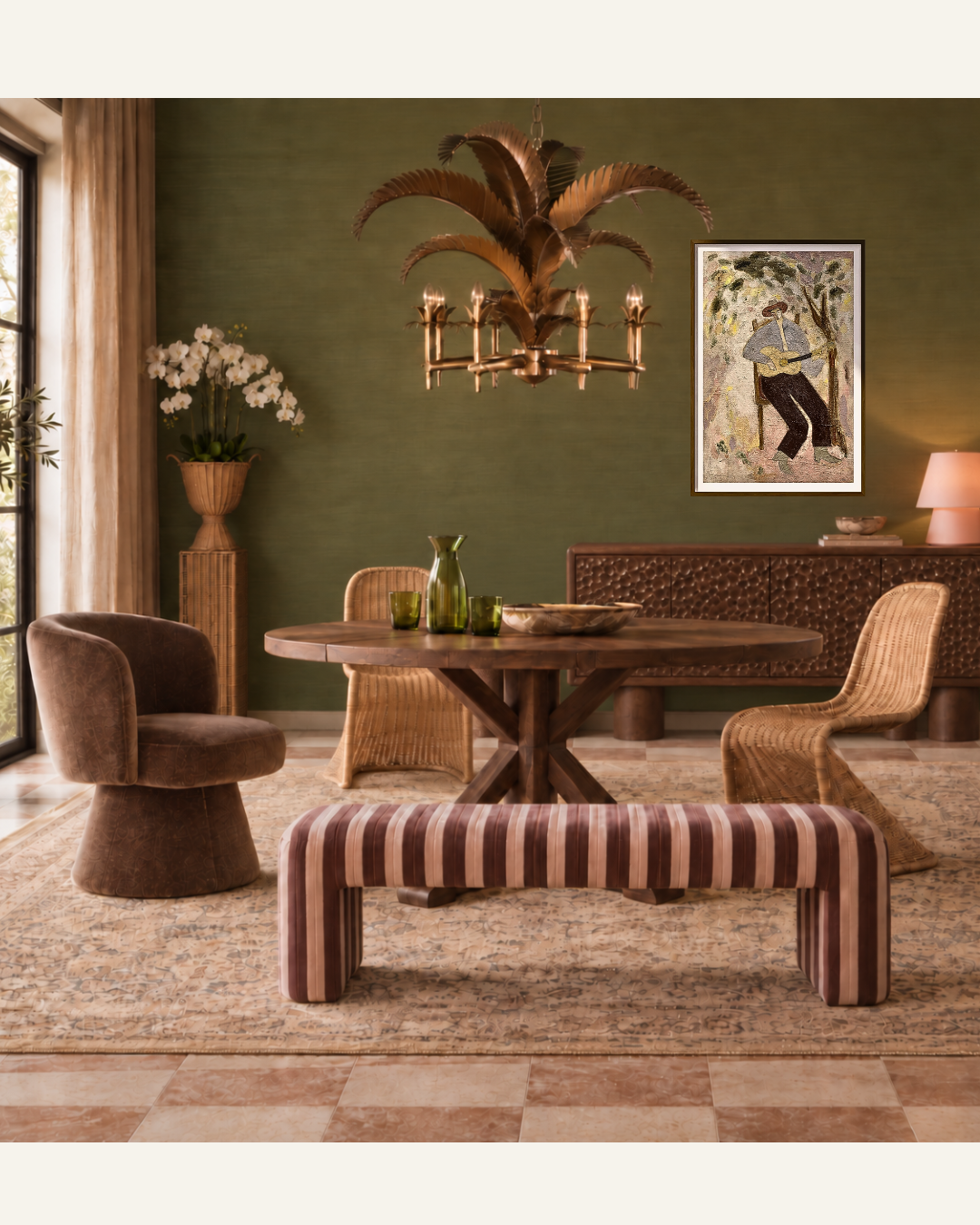
Room enough to pull a chair back, reach the sideboard, and never once apologise for squeezing past someone.
Art Credit: Echoes in the Shade, by Brittany Ferns (brittanyferns.com)
Start with how people will actually move through the room
Before you think about what belongs on the table, look at what happens around it.
Can someone pull out a dining chair comfortably? Is there a natural path from the kitchen to the dining area? Does the room still work once there are more bodies in it than usual?
These aren't glamorous questions, but they're the difference between a room that feels generous and one that quietly becomes an obstacle course.
Furniture placement is often decided from the edges inward. Sofa against wall. Sideboard where it fits. Chairs tucked into whatever space remains.
Hosting asks for a different approach.
Think about how the room behaves once people are in it.
Where do they naturally stop? Where will someone put a glass while they're talking? Can a person pass behind a chair without making everyone else move?
Sometimes the answer is not buying anything at all.
It might just be moving one piece by thirty centimetres. Nobody at dinner will ever know that's all it took.
Your dining table is an anchor, not an island
A dining table has a surprisingly big job.
It sets the scale of the room and influences almost everything around it: the chairs, the rug, the lighting and how easily people can move through the space.
Which is why choosing one in isolation can unravel fairly quickly.
A round table can be especially useful where conversation and circulation matter. There's no head of the table, fewer hard corners to negotiate, and the shape naturally encourages people to speak across the whole setting rather than separating into two ends.
But the table still needs support.
The chairs have to make sense beside it in height and proportion. The pendant above should respond to the shape rather than fight it. If there's a rug underneath, it needs enough room for chairs to move without teetering off the edge.
Then look beyond the table itself.
A sideboard nearby can take enormous pressure off the dining surface. Extra plates can live there. So can glassware, serving pieces or the flowers someone brought that turned out to be far too tall for conversation.
The strongest dining rooms don't ask one piece to do everything.
They let the room work as a whole.
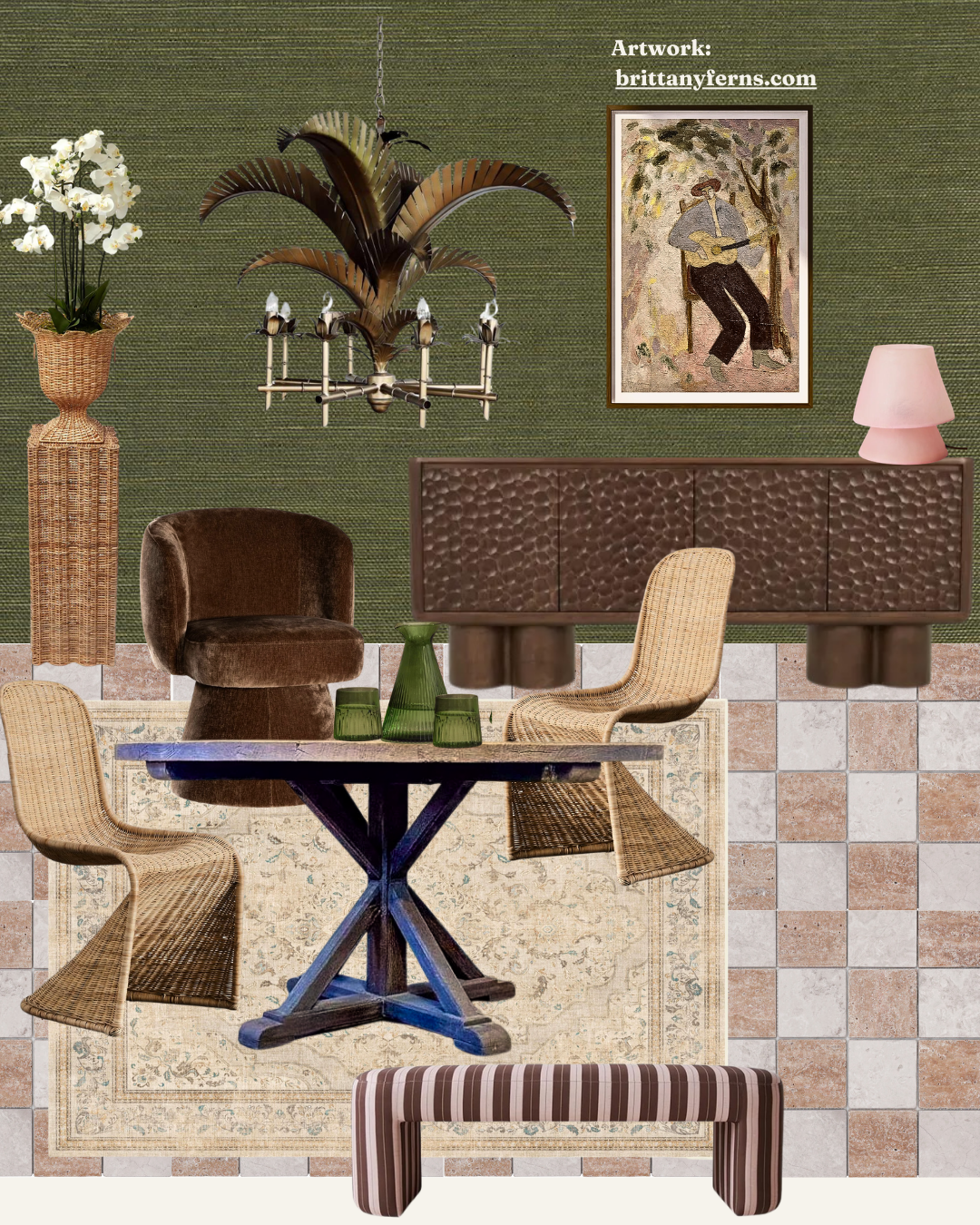
Built around the Sandalwood Round Dining Table from Marigold Interiors, this scheme gives one strong anchor enough texture and contrast to carry the room.
Art Credit: brittanyferns.com
Not every seat has to match
If spring hosting means borrowing a chair from the study, I'm very much in favour.
A room doesn't stop working because every seat is different.
In fact, a little variation often gives a dining space more personality.
Matching dining suites can be perfectly respectable and still feel a little flat. Bring in a different silhouette or material and the room can suddenly feel more collected.
The trick is giving the pieces something in common.
Maybe the warm timber of one chair speaks to the table. Perhaps a woven seat picks up texture elsewhere in the room. A deeper upholstered chair might connect visually to a sideboard or artwork.
You don't need everything to match.
You do need a thread.
Collected does not have to mean chaotic. The room simply needs enough connection between the pieces that they feel like they belong in the same conversation.
Even if they absolutely did not arrive together.
Give guests somewhere to put things
This is one of the least glamorous parts of a good room. It is also one of the most useful.
People arrive carrying things. Bags get put down, keys need somewhere to land, and the bottle of wine someone brought has to go somewhere before the hugging can begin.
Then, once everyone sits down, there are glasses and plates to deal with. A room designed for people needs useful surfaces. That might be a side table beside an occasional chair. It could be a console behind the sofa or a small drinks table between two seats.
You don't need to fill every corner. You just need to notice where people instinctively reach for a surface and discover there isn't one.
That small snag tells you quite a lot.
Look at your lighting before 7pm
A room can behave perfectly well in daylight and become something else entirely after dinner.
One ceiling light rarely does enough.
What matters more is having light at different heights and in the places where people actually spend time.
A dining pendant can anchor the table visually. A lamp beside a chair gives that corner a reason to exist after dark. Light falling across artwork or a sideboard adds depth to a room that might otherwise feel flat once the sun goes down.
And, importantly, people generally look better under layered light. A fairly persuasive argument on its own.
If you're hosting in spring, try this before anyone arrives: turn on the lights you normally use at the time guests will actually be there.
Then stand at the doorway and look again.
What disappears? Where is the room too bright? Is somebody about to spend the evening sitting directly beneath a ceiling light that feels more dental surgery than dinner party?
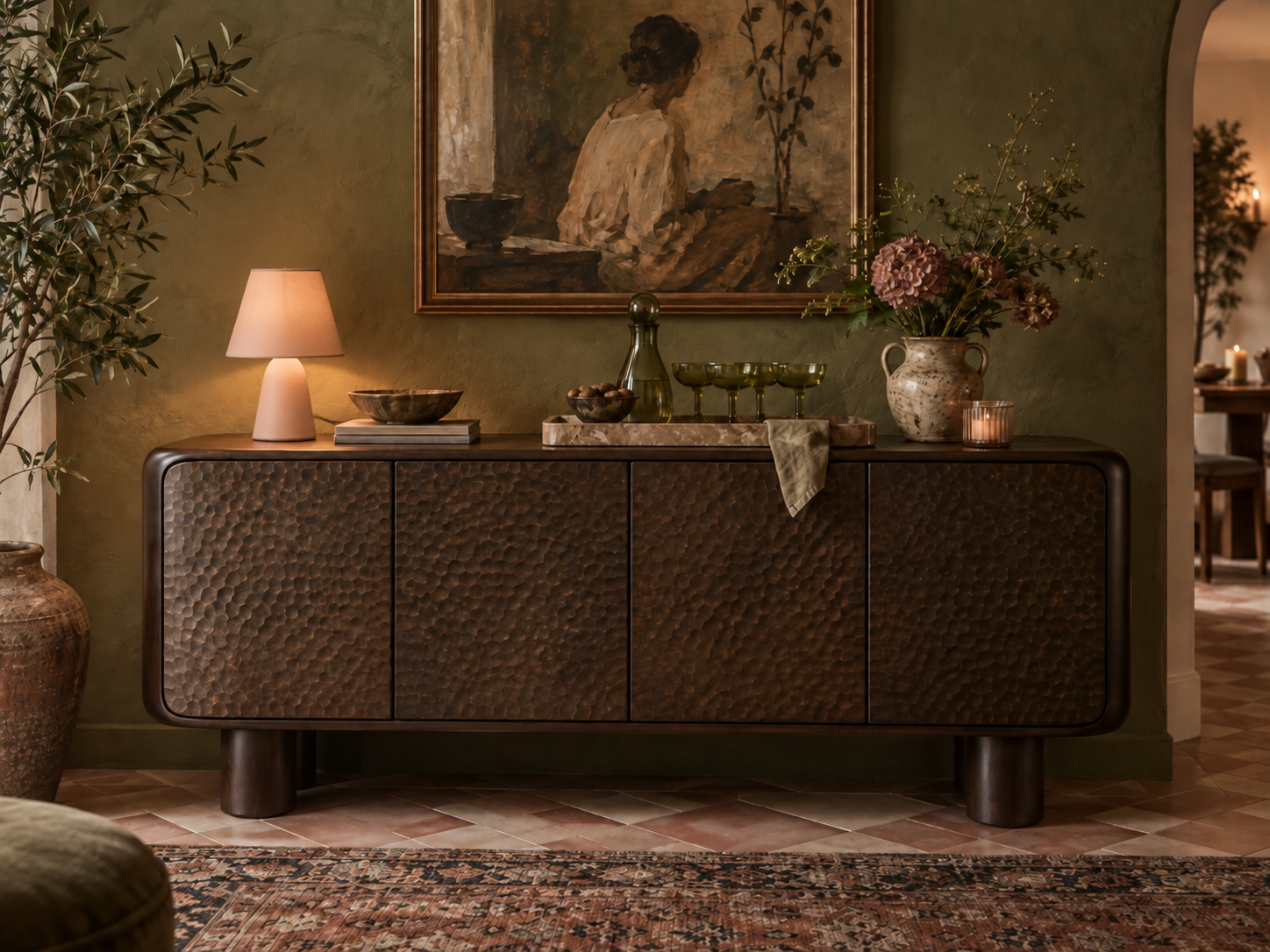
The Inez Sideboard from Globe West, doing exactly what a good sideboard should: quietly holding everything the table can't.
Make one strong decision before adding the spring bits
Spring has an alarming ability to convince us we urgently need new cushions. Possibly in stripes. Maybe a ceramic bowl.
Step away from the cushion aisle for a moment.
If the room still feels unfinished, adding seasonal decoration probably won't fix the real issue.
More often, the problem is something underneath the styling. The furniture may be out of scale. The layout may be too polite. Perhaps the room has plenty of nice things but nothing with enough presence to hold them together.
Good rooms start with one strong decision.
It could be the dining table. Or the artwork you've owned for years and never quite knew where to put.
Once there's an anchor, the smaller choices become much easier because they have something to respond to.
Without one, it's surprisingly easy to spend money on perfectly nice pieces that remain perfectly unrelated.
Annoying, I know.
Leave enough room for the room to change
Hosting is temporary.
Your furniture arrangement doesn't have to behave as though every Saturday involves twelve people for lunch.
What matters is whether the room can adapt when you need it to.
Maybe an occasional chair can be pulled closer to the conversation. Perhaps there's space for one more dining chair without blocking the room completely. A lightweight side table can move when somebody needs it.
The best rooms have a little give in them.
They aren't so precisely arranged that moving one chair ruins the whole composition.
Homes change because life does.
Guests arrive. Someone sits on the floor. A chair gets dragged in from another room. Food migrates from the kitchen to the dining table and then, somehow, to the coffee table.
The evening develops its own plan.
Let it.
What your space actually needs before people arrive
Probably less than you think.
You don't necessarily need a new dining setting or a fresh round of seasonal accessories.
You need to know whether the room has a clear anchor, and whether people can move through it comfortably once it fills up.
Then look at the details that only become obvious when guests are actually there.
Is there somewhere sensible to put a drink? Does the lighting still work after sunset? Does the room feel connected, or like a collection of nice pieces that happen to share an address?
That's often where good interior design in Melbourne earns its keep. Not in adding more for the sake of it, but in making sure the room underneath the occasion actually works.
Once that part works, the flowers can come in. The wine can be opened. And everyone can get on with enjoying the room instead of working around it.
If a friend came to mind while you were reading this, the one with the awkward dining room, or the aunt who keeps rearranging the same three chairs, send it their way. It might be the nudge they need to look at the room differently.
And if it was your own room you kept picturing: which part of it isn't working? The seating, the lighting, the table that's never quite sat right? Drop me a note at hello@haloandfitz.com.au, or book a free twenty-minute Align + Define Call if you'd rather talk it through properly. Either way, I'd genuinely love to hear.