

When a Room Looks Beautiful But Still Feels Unfinished
The room is nice.
The pieces are quality. Nothing is obviously wrong. You have made considered choices, spent proper money, measured twice, saved images, compared fabrics, waited for delivery windows, and talked yourself out of at least three impulsive lamps.
And yet.
You walk in and feel nothing.
Not dislike, exactly. Not regret. Just a small, flat pause. The room looks acceptable from the doorway, maybe even attractive in a photo, but it does not seem to hold you. It does not say much about where you have been, what you notice, how you live, or what kind of mood you want the room to carry when the day has finally stopped asking things of you.
This is one of the more frustrating design problems because it can hide inside perfectly good taste. The sofa is not the issue. The rug is not offensive. The artwork is not wrong. The cushions have behaved themselves.
Still, the room does not feel like yours.
And usually, the answer is not more shopping.
It is structure.
For many people searching for interior design support, the problem is not that they have made bad choices. It is that each choice has been made in isolation. One by one. Carefully. Sensibly. Politely. Until the room has become a collection of reasonable decisions with no clear point of view.
That is the “fine” trap.

A neutral living room can be a beautiful space, but it can still feel unresolved and lacking in character, personality and feeling if there’s nothing that tells us anything about who actually lives here.
The “Fine” Trap
A fine room is rarely a disaster.
That is what makes it so annoying.
A fine room has the linen sofa, the timber coffee table, the ceramic lamp, the rug that goes with everything, the artwork that does not cause trouble, and the sideboard that was bought because the wall needed “something there.”
Individually, each piece passes.
Together, they cancel each other out.
One choice softens the next. One safe decision quietens the one before it. The palette becomes pleasant but vague. The furniture sits where it is meant to sit, but nothing leads. No object has enough authority to make the rest of the room answer to it.
The result is not bad taste.
It is the absence of an anchor.
Without an anchor, the room starts drifting. You add a throw to bring in colour, then choose cushions to make the throw make sense, then buy a vase because the coffee table looks bare, then wonder whether the artwork is too small, then decide the rug might be the problem, then reopen every furniture tab you promised yourself you were done with.
This is how a room becomes full and still feels unfinished.
The eye has nowhere to land. The room has no beginning. Nothing is strong enough to set the tone, so every later decision has to work too hard. The pieces are not in conversation. They are standing near each other, being polite.
And polite rooms are often the ones that feel least personal.
A home that feels like you does not need to be loud. It does not need to announce your entire biography through one heroic cabinet. But it does need conviction. It needs a thread that can be followed from the biggest decision to the smallest one: the curve of a chair, the depth of a wall colour, the scale of a lamp, the texture of a cushion, the way a piece from one chapter of your life can sit beside something new without either of them looking stranded.
That thread is what stops a room from feeling assembled.
It is also what separates a room that looks nice from one that actually feels like someone lives there.
Taste Is Not the Same as Structure
Good taste helps.
Of course it does.
It means you know what you are drawn to. You can spot a good material. You have an instinct for things with character. You probably have a saved folder full of rooms that are layered, textural, warm, collected, and nothing like the flat-pack showroom corner you are quietly trying to avoid.
But taste alone does not automatically create a resolved room.
Taste is selection.
Structure is direction.
Taste says, “I like this.” Structure says, “This belongs here, because the room is doing this.”
That difference matters.
Without structure, good taste can actually make the problem more confusing. You are not choosing from bad options. You are choosing from too many good ones. A striped armchair, a vintage mirror, a Moroccan tray, a rust-toned cushion, a sculptural lamp, a framed textile, a timber side table with lovely legs. Each has merit. Each could work somewhere. But not all of them can lead the room at once.
A room cannot have twelve main characters.
This is often where people get stuck. They assume the missing thing must be another object. A bigger artwork. A better rug. A different coffee table. A more interesting lamp. And sometimes, yes, one piece may be missing. But more often, what is missing is not more.
It is the thread.
The thread is the logic running through the room. It is the reason the palette does not wander off. It is the reason the materials feel related without matching. It is the reason an old piece from your travels, a new sofa, a rental wall, a handmade bowl, and a slightly odd vintage chair can all sit together and feel intentional.
This is especially true with layered interiors. The more personal and collected a room becomes, the more structure it needs. Not rigid rules. Not a catalogue formula. Just enough design logic to hold the richness together.
Because collected does not have to mean chaotic.
And personal does not have to mean visually noisy.
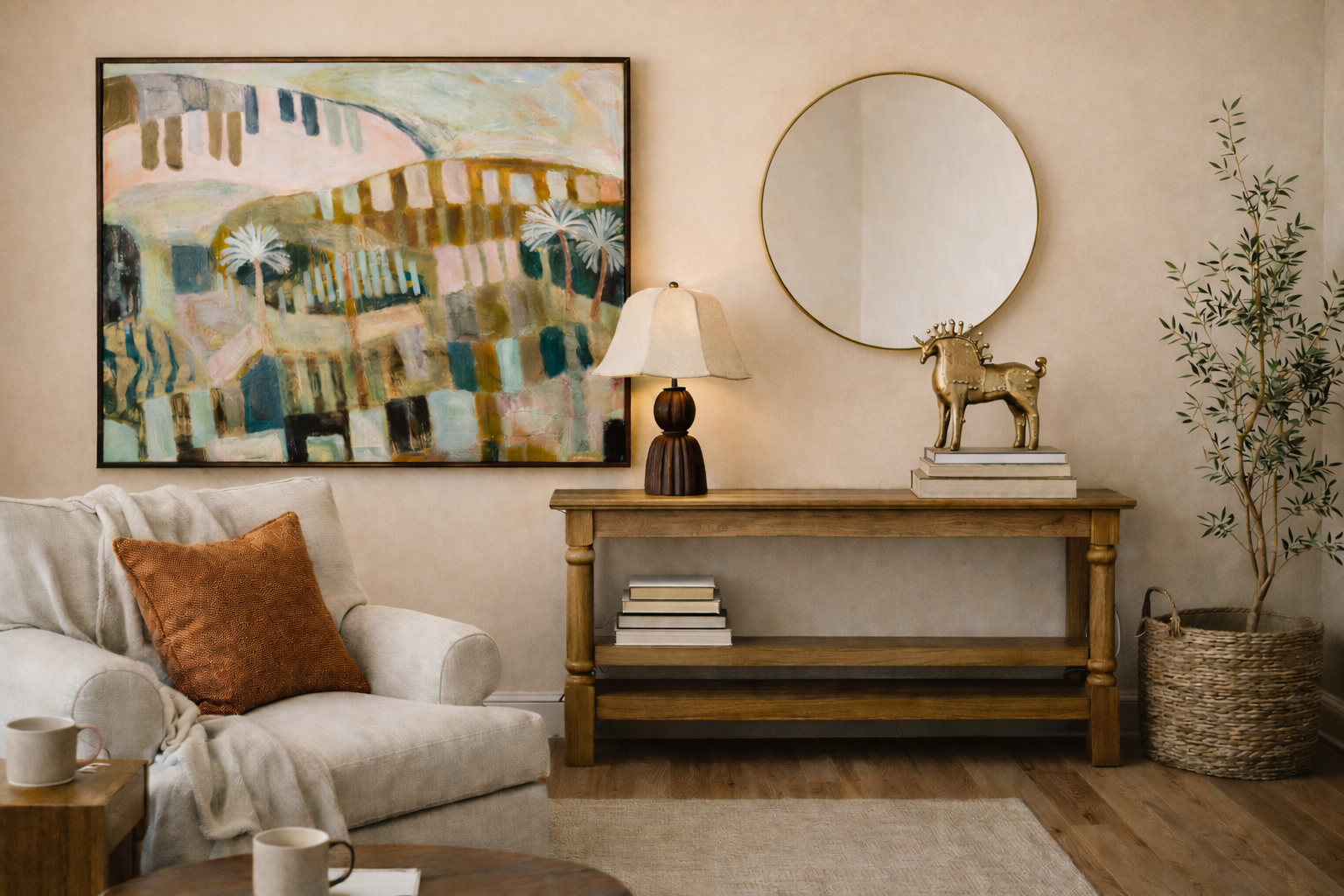
Layered interiors have “heart” - Design by Studio Halo & Fitz.
An aged timber console, textured ceramic-base lamp, quality natural linen fabrics, and a brass horse statue add depth and and contrast to this living space. We built the room’s collected design details around this beautiful artwork.
The One Decision That Changes the Room
The rooms that feel most like their owners usually have one very clear decision at the centre. Everything else responds to it.
Sometimes the decision is a piece of furniture. Sometimes it is a textile. Sometimes it is a painting, a rug, a wall colour, a family piece, or an object brought home from somewhere that still sits in your memory with strange clarity.
The point is not that the anchor is expensive.
The point is that it gives the room a reason.
An anchor piece is the first strong decision.
Not necessarily the first thing you buy. Often, it is already in the house. It might be the thing you keep moving from room to room because you love it, but you cannot quite make it work. It might be the only object in the room with any real emotional charge. It might be the piece that has better posture than everything around it.
The anchor has weight.
Not always physical weight. Visual weight. Emotional weight. A sense that the room would lose something if it disappeared.
Once the anchor is identified, the rest of the room stops being a series of separate decisions. It becomes a response.
A deep red artwork might pull warmth into the timber, make a clay-toned cushion make sense, and explain why the walls need something softer than plain white. A patterned rug might give the palette its rhythm, allowing the sofa to stay simple but not bland. A vintage cabinet might introduce age and depth, so the lighting and ceramics need to meet it with texture rather than shine.
The anchor does not bully the room.
It gives it a spine.
This is why one room can change so quickly once the anchor is found. The questions become clearer. Not “Do I like this?” but “Does this answer the room we are building?” Not “Is this nice?” but “Does this strengthen the thread?”
In the Red Brick Reset, the turning point was not a material or a piece of furniture. It was listening carefully to what the client kept saying they wanted the home to feel like.
They were not asking for a room that simply looked more polished. They wanted the home to feel warmer, more grounded, more personal, and more reflective of who they were becoming in that chapter of life. That became the anchor.
Once that emotional direction was clear, the design decisions had something to answer to. The palette could deepen. The materials could feel more tactile. The styling could become more personal without becoming cluttered. New pieces could be chosen not because they were simply beautiful, but because they helped the home feel more like the people living in it.
That is the work of an anchor.
It does not always begin with an object. Sometimes the anchor is a sentence the client says without realising how important it is. Sometimes it is a feeling they keep circling back to. Sometimes it is the gap between the home they have and the home they are ready to grow into.
Once that anchor is understood, the design decisions stop floating. They start belonging.

The One Decision That Changes the Room
A living room that needed an anchor piece - the iconic Italian head vase is known as Testa di Moro or Moor’s Head. Originating from Sicily, this hand-painted ceramic vase was sourced from Fenton & Fenton, and adds that Global Resort thread the client was looking for. It adds warm, whimsy, texture and design direction.
What to Do Next
Start with one room.
Not the whole house. Not every unresolved corner. Not the cupboard where your spare cushions go to wait for their next identity crisis.
One room.
The room you keep adjusting. The room that looks fine but never quite lands. The room where every new purchase seems to help for three days and then somehow disappears into the general “almost.”
That is the room asking for an anchor.
In the Passport Plan, we begin there. One room. One clear direction. The anchor found, the thread named, and the remaining decisions resolved around it.
That might mean working with a piece you already own. It might mean identifying what the room is missing. It might mean clarifying the palette, sourcing key pieces, mapping the layout, and giving every item a job so the room stops feeling like a group project with no leader.
For clients looking for e-design Australia services, this is the part that often brings relief. You do not need to be in the same suburb, or even the same state, to solve the room properly. With interior design online Australia, the process can still be personal, specific, and grounded in how you live. Photos, measurements, existing pieces, stories, frustrations, and the things you cannot quite articulate all become part of the brief.
The Passport Plan is not about wiping the room clean.
It is about finding what is already trying to lead, then building enough structure around it for the room to feel resolved.
Because the answer to a room that looks good but does not feel like you is not always to start again.
Sometimes the room is much closer than you think.
It just needs one strong decision.
Ready to Find the Thread in Your Room?
If your room looks good on paper but still doesn't feel quite like you, the Thread Test will show you exactly what's missing — ten questions, completely free.
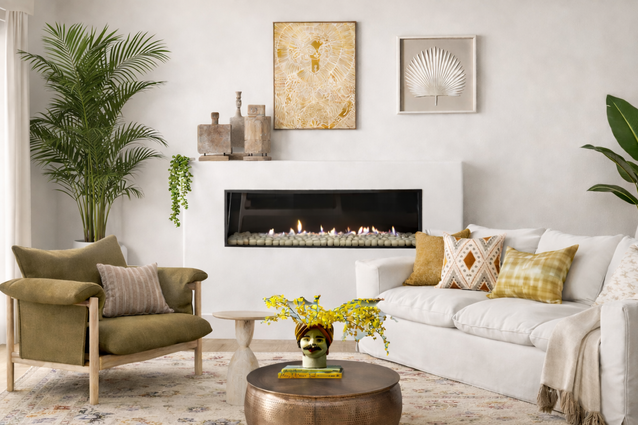
A Living Room with Attitude and a Sense of Humour
This living room now reflects the client’s love of travel and personality without it looking like the inside of a tourist shop.