

The Real Reason Your Home Doesn’t Feel Like You Anymore
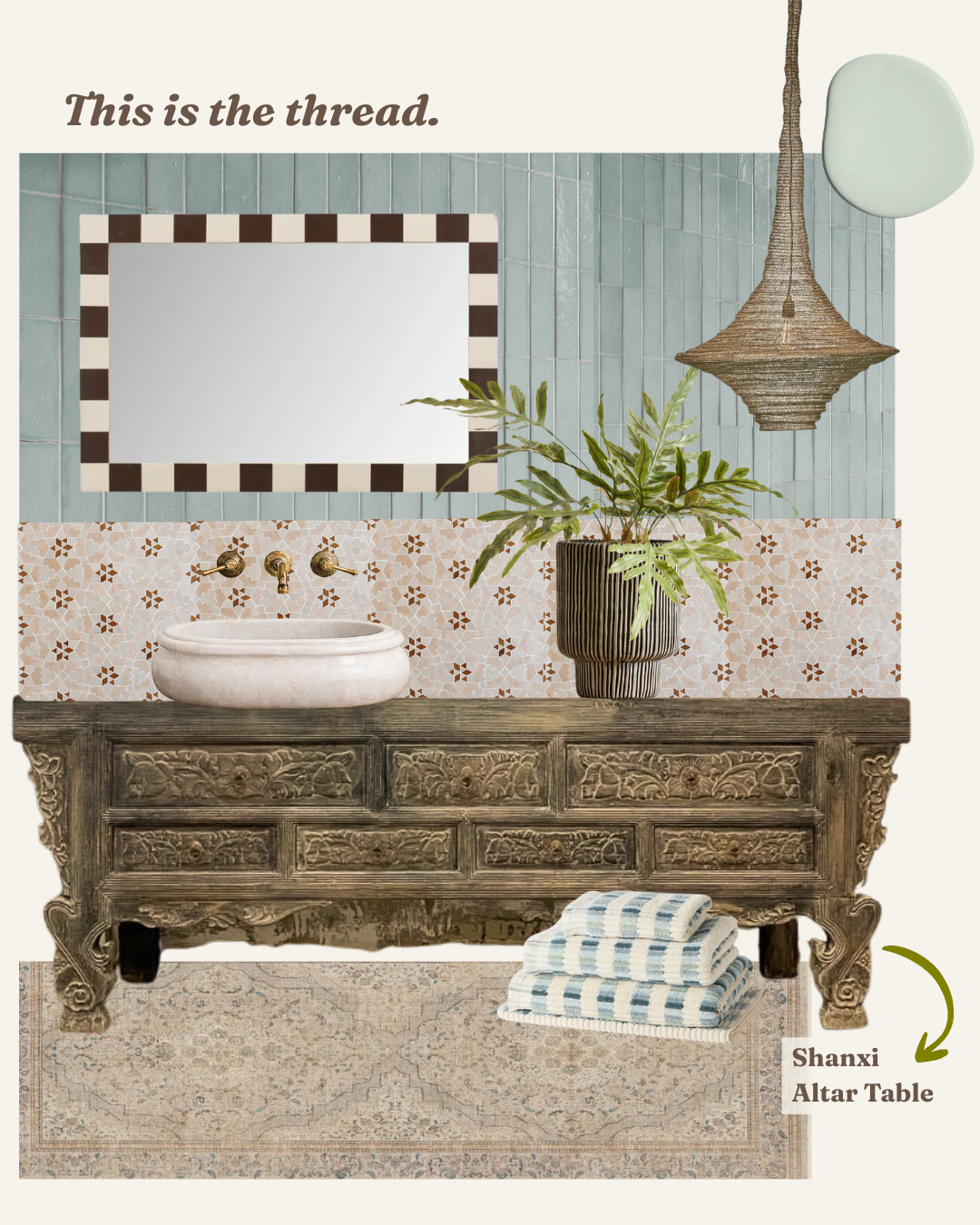
Global Resort Ensuite ~ design by Studio Halo & Fitz
A rare 5-drawer Shanxi Altar Table from @marigold.interiors reimagined as an ensuite vanity — one strong design decision giving the whole room a thread.
Sometimes the house isn’t wrong.
It’s just still dressed for an old version of your life.
That can be an odd thing to realise, because nothing has to be dramatically bad for a home to stop feeling like you. The sofa might be perfectly nice. The rug might be fine. The artwork might still be something you love. There may be no obvious disaster. No alarming corner. No single chair quietly ruining everyone’s afternoon.
And yet, something feels off.
You walk into the room and it does not quite meet you where you are anymore. It belongs to a previous routine, a previous relationship, a previous version of family life, a previous country, a previous idea of what home was supposed to be.
It may have made perfect sense once.
That does not mean it still has to.
At Studio Halo & Fitz, this is often where the real design work begins. Not with buying more things. Not with copying a room from Pinterest. Not with deciding everything needs to go.
The better question is quieter than that.
What still belongs here?
And what no longer fits the life you are actually living?
A room needs something to answer to
A room often starts to come together when one decision is strong enough for every other choice to answer to.
In this week’s Instagram carousel, that decision was a Shanxi Altar Table reimagined as an ensuite vanity.
Not a standard vanity. Not something anonymous and politely practical. A carved, timeworn, characterful piece with enough presence to lead the room.
Once that decision was made, the next choices had something to anchor themselves to. The handmade tiles, the bold checkerboard mirror, the antique brass pendant light, the rug, the styling — they were no longer floating around as separate ideas. They had a thread.
That is what good design direction does.
It gives every next decision somewhere to belong.
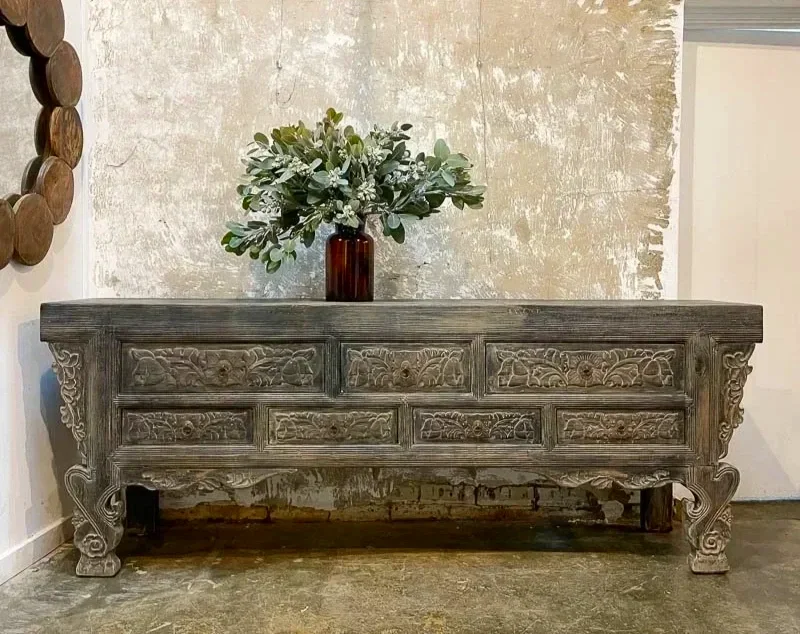
One-of-a-kind furniture, not mass-produced.
The starting point: a Shanxi Altar Table with enough character to lead the room.
Your home works the same way
The same thing happens at the scale of a whole home.
When a home no longer feels like you, it is often because the rooms are still answering to an older brief.
The living room might still be arranged around how you used to entertain. The bedroom might still hold the energy of a life stage you have moved through. The spare room might be full of decisions made in a hurry after a move, a separation, a return from overseas, or a period where getting through the week mattered more than making the house feel like yours.
Understandably.
Homes are not created in one clean, cinematic sweep. They accumulate. They absorb moves, compromises, gifts, inherited pieces, rushed decisions, children growing up, jobs changing, budgets shifting, relationships beginning and ending, and all the tiny practical choices that happen between school runs, deadlines and the washing machine making that noise again.
So if your home feels slightly misaligned, it does not mean you have failed at design.
It may simply mean the room is still holding a version of your life that no longer needs quite so much space.
You may be trying to solve an emotional mismatch with furniture
This is where people often start shopping.
A new lamp. A different rug. A cushion that looks promising in the aisle. A side table that might finally pull things together if everyone behaves.
It probably won’t.
Annoying, I know.
Not because the piece is wrong. Not because you have bad taste. Often, the opposite is true. Many of my clients already own good things. Interesting things. Pieces with memory, texture, travel, story, or proper usefulness.
The problem is not always the furniture.
The problem is that the room has no current point of view.
Without that, every new purchase has to work far too hard. It is expected to fix the feeling, create the cohesion, update the room, reflect your taste, respect the budget, and somehow make the whole space feel more like you by Tuesday.
No cushion deserves that kind of pressure.
Good design starts long before the cushions and the coffee table.
It starts with working out what the room is actually here to do now.
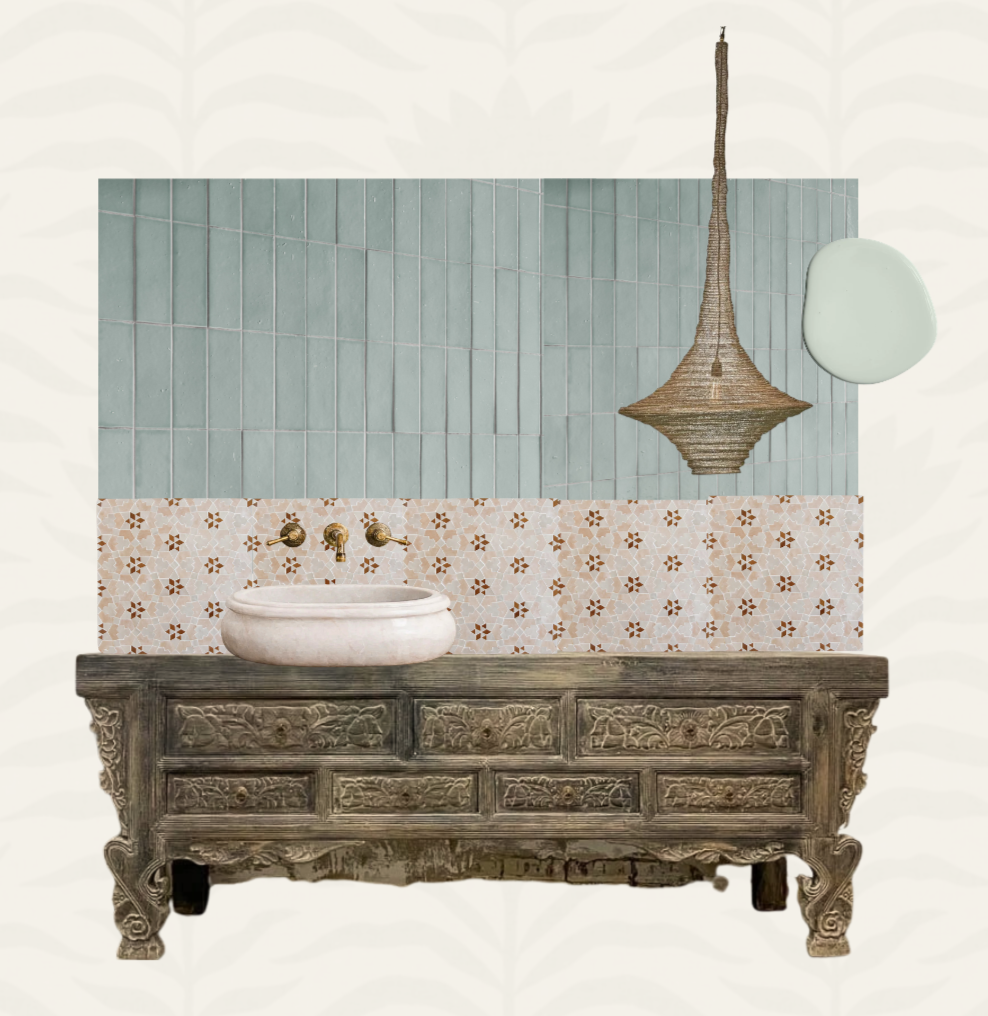
Handmade zellige tiles and mosaic border + antique brass mesh pendant light and tapware + marble basin.
Once the anchor is clear, the next choices have something to answer to.
Your taste may have moved on before your home did
This is very common after a shift in life.
You may not want a completely different home. You may not even want a completely different room. But the version of you who made those original choices may not be the person standing in the doorway now.
Perhaps you have travelled more. Seen more. Lived elsewhere. Developed a stronger sense of what feels good to you. Perhaps you have stopped wanting everything to be safe, neutral and agreeable. Perhaps you have realised that a room can be polished and still feel empty.
Or perhaps the shift is more personal.
A divorce. A sea-change. A career pivot. Children leaving home. Returning to Australia after years away. Moving into a rental after owning. Buying a home after years of compromise. Starting again in ways that are practical, emotional, and very rarely tidy.
Your home may still be telling the old story very loudly.
That does not mean you need to erase it.
It means the edit needs to be more intelligent.
What still carries meaning? What can be reinterpreted? What needs to be moved, softened, strengthened, sold, stored, reframed or finally allowed to leave?
A home can hold memory without keeping you stuck.
That is the difference.
The answer is not always to start again
Starting again sounds decisive. It can also be expensive, wasteful and strangely impersonal.
At Studio Halo & Fitz, I am much more interested in finding the thread that already exists somewhere in the room — even if it is buried under a few hesitant purchases and one lamp that has been trying its best since 2017.
That thread might be an artwork. A rug. A cabinet. A tile. A memory of a place. A colour you keep returning to. A piece you brought back from overseas. A chair inherited from someone who mattered. A feeling you cannot quite explain yet, but know when you see it.
That is where the work begins.
Not with a style label.
With recognition.
Because a room should not feel like a showroom version of someone else’s taste. It should feel like your life, edited with more clarity.
Character first. Catalogue last.
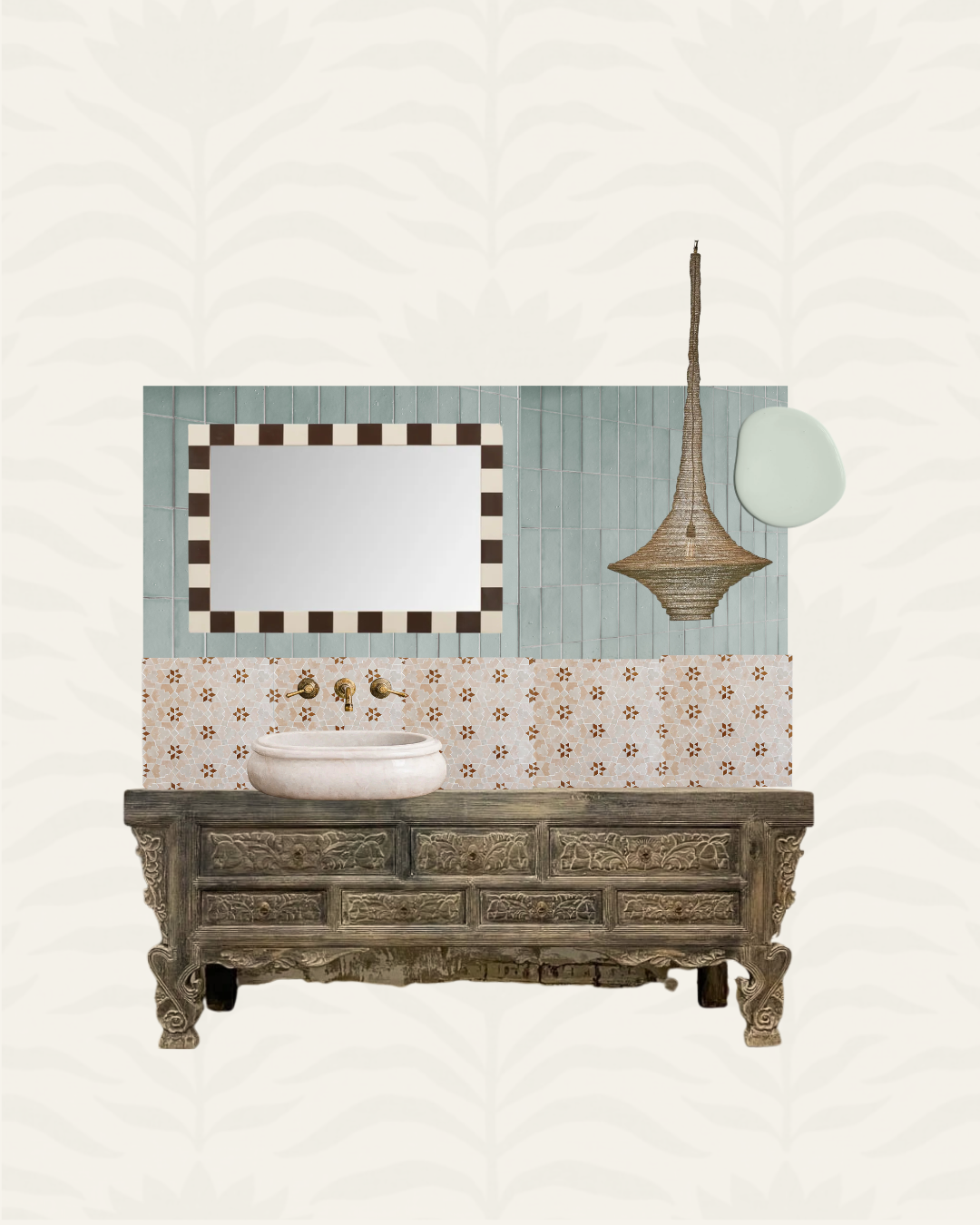
A bold checkerboard mirror adds a spark, some punch.
The room begins to find its point of view — layered, specific, and led by one strong decision.
Start with one room
If the whole house feels too much to solve, start with one room.
That is often enough.
One room gives you a place to practise a new point of view. A place to make stronger decisions. A place to understand what still belongs and what no longer fits. Once that room has direction, the rest of the home often becomes easier to read.
That is exactly where The Passport Plan comes in.
The Passport Plan is for the room that has good pieces, good intentions, and no clear direction yet. It gives one space a fully reimagined design direction, including a sourced mood board, layout guidance and styling notes, so you can move forward without second-guessing every purchase.
Not a generic look.
Not a room bought in one stop.
A clearer thread.
One room. One clear direction.
When your home no longer feels like you
If your home feels like it belongs to an older chapter, you do not need to solve everything in one breath.
Begin by noticing what feels misaligned.
The room you avoid. The corner that irritates you. The furniture that technically works but emotionally belongs somewhere else. The pieces you still love but cannot quite make sense of anymore.
There is information in that discomfort.
The house may not be wrong.
It may simply be ready for a clearer direction. From holiday to home, paradise reimagined.
Ready to find the thread?
If your home feels like it belongs to an older chapter, you don't need to solve everything at once — or even know where to start. The Thread Test will show you what's missing, room by room.

Kathryn Farrell, Interior Designer and Founder of Studio Halo & Fitz.
Email me hello@haloandfitz.com.au - I’d love to hear which of your rooms needs a stronger thread.