

A Home Office Worth Spending Time In: Start With One Piece You Love
Five steps to a home office that is practical, personal and full of character.
Somewhere along the way, the home office became the room for sensible desks, practical storage and chairs that look as though they’ve escaped from a corporate meeting room.
Functional, yes. Inspiring, rarely.
It is still part of your home, and it deserves the same personality as every other room. Whether you work remotely from home full-time or several days a week, run a business or simply need somewhere to face life admin, you will spend a lot of hours in it.
The way in is one strong decision. One piece you love, with personality, presence or a story to tell. I call this the Hero Principle: choose one piece with personality to anchor the room, then let every other decision respond to it.
Here is how to build a room around it.
1. Start with how you actually work
Before falling in love with a beautiful antique desk (a trap I know well), get clear on what the room has to do. Eight hours at a computer? Video calls and paperwork? Sketching or working with materials? Does it double as a guest room?
Daily computer work needs supportive seating, the right desk height and well-placed lighting. A gorgeous vintage chair can look wonderful and still defeat an eight-hour day, so if you love it enough, give it a role elsewhere in the room.
Light deserves the same attention. A desk facing the window offers a beautiful outlook but it’s a recipe for daily eye strain and fatigue. Turning the desk perpendicular to the window usually balances both. Then layer your lighting: a good task lamp for focus, a decorative lamp or pendant to make the room feel welcoming.
Power points, cables and printers are far easier to plan now than to disguise later. Check that you can pull out your chair, open the drawers and reach whatever you use every day.
2. Choose your hero piece
This is where the room gets interesting.
Rather than starting with a matching desk, chair and storage system, begin with the one piece that gives the room its direction. A vintage desk with beautiful timber grain. An upholstered chair in an unexpected colour. An antique cabinet, a striking artwork, a rug that stops you in the doorway.
It might be inherited, found in a vintage shop or carried home from your travels. Price and grandeur matter far less than having enough personality to influence what happens next.
Your hero can even be the least practical thing in the room. A sculptural armchair sets the palette while a supportive task chair handles the working day. A vintage cabinet brings the character while a simpler desk quietly does its job.
The hero gives the room a point of view. Everything else responds to it.
A LITTLE INSPIRATION FROM MY LATEST MOOD BOARD

Studio Halo & Fitz | Home Office Mood Board of the Month.
A vintage red cabinet sets the direction, with additional colours, textures, and playful artwork bringing the room together.
Art Credit: Samba by Kerrie Jeffs.
For my latest Home by Halo newsletter Mood Board of the Month (October edition), I put the Hero Principle to work. I started with one piece, the Kallie Vintage Almirah cabinet, and chose everything else in response to it.
The cabinet is richly coloured and full of intricate detail. It first caught my eye during a recent visit to Marigold Interiors, one of my favourite furniture and homewares stores and an absolute treasure trove of character pieces. A curved chair in blackberry velvet brings softness and an unexpected colour pairing. A substantial timber desk adds warmth, the olive-gold sisal wallpaper adds texture and contrast, while the washable wool rug brings pattern underfoot. The woven pendant adds another natural material, and a playful artwork keeps the room from taking itself too seriously.
Periods, materials and influences are mixed, yet the pieces have a relationship with one another. The result feels collected over time. A thread holds it together, and the cabinet is where that thread starts.
3. Let your hero set the palette
Once you have your starting point, let it lead your colour choices.
This is where people get hesitant. They find something they love, then surround it with the safest possible colours for fear of getting it wrong. Making every decision a little too polite leaves a room flat.
Look closely at your hero instead. Which colours can be repeated elsewhere? Is there an unexpected shade worth borrowing?
In my mood board, the antique cabinet introduces a deep, earthy red, joined by muted plum, warm timber, olive green and touches of brass. None of the colours are identical, but they share a richness that lets them sit comfortably together.
Start with one dominant colour, one or two supporting shades and natural materials for balance. Colour also needs no even distribution. Sometimes a single beautifully upholstered chair supplies all the colour a room needs. The artwork adds an unexpected pop of cool blue to the colour palette, saving it from reading too linear in temperature throughout. A room needs a little more friction and variation to be interesting.
4. Layer texture and pieces with a story
A home office turns one-dimensional fast when everything comes from the same furniture range. The desk matches the shelving. The shelving matches the filing cabinet. The chair is suitably sensible. Everything coordinates and there is nothing to discover.
I prefer rooms where different pieces have found their way together. A vintage timber desk beside a contemporary lamp (or vice versa). A handwoven rug under a modern chair. An antique cabinet holding books and ceramics collected over the years…or in my case, tile, tapware, laminate and fabric samples.
These combinations create depth, and they give your own experiences somewhere to live: a painting from a gallery overseas, a ceramic vessel from a market, a textile that reminds you of somewhere you’ve lived. Local galleries, antique dealers and independent makers are also full of pieces with individuality, so you can begin close to home.
Give your favourite pieces room to be appreciated. A collected room stays personal when each piece has space around it.
5. Look beyond office furniture, then add the details
One of my favourite ways to bring in personality is to reconsider what counts as office furniture. A two-door oak cupboard can look after the room’s hospitality and its admin: coffee machine, glasses and mugs on the shelves above, printer and stationery tucked away below. An antique dining table makes a wonderful desk. A vintage sideboard can hold files and equipment. Even a narrow console table can serve as a writing desk if you don’t need a tonne of room to spread out. I do. Reference books, paperwork, and tile, tapware, laminate, colour and fabric samples all need somewhere to land. Check desk height, legroom and proportions before you commit.
AN UNCONVENTIONAL HOME OFFICE FURNITURE SOLUTION
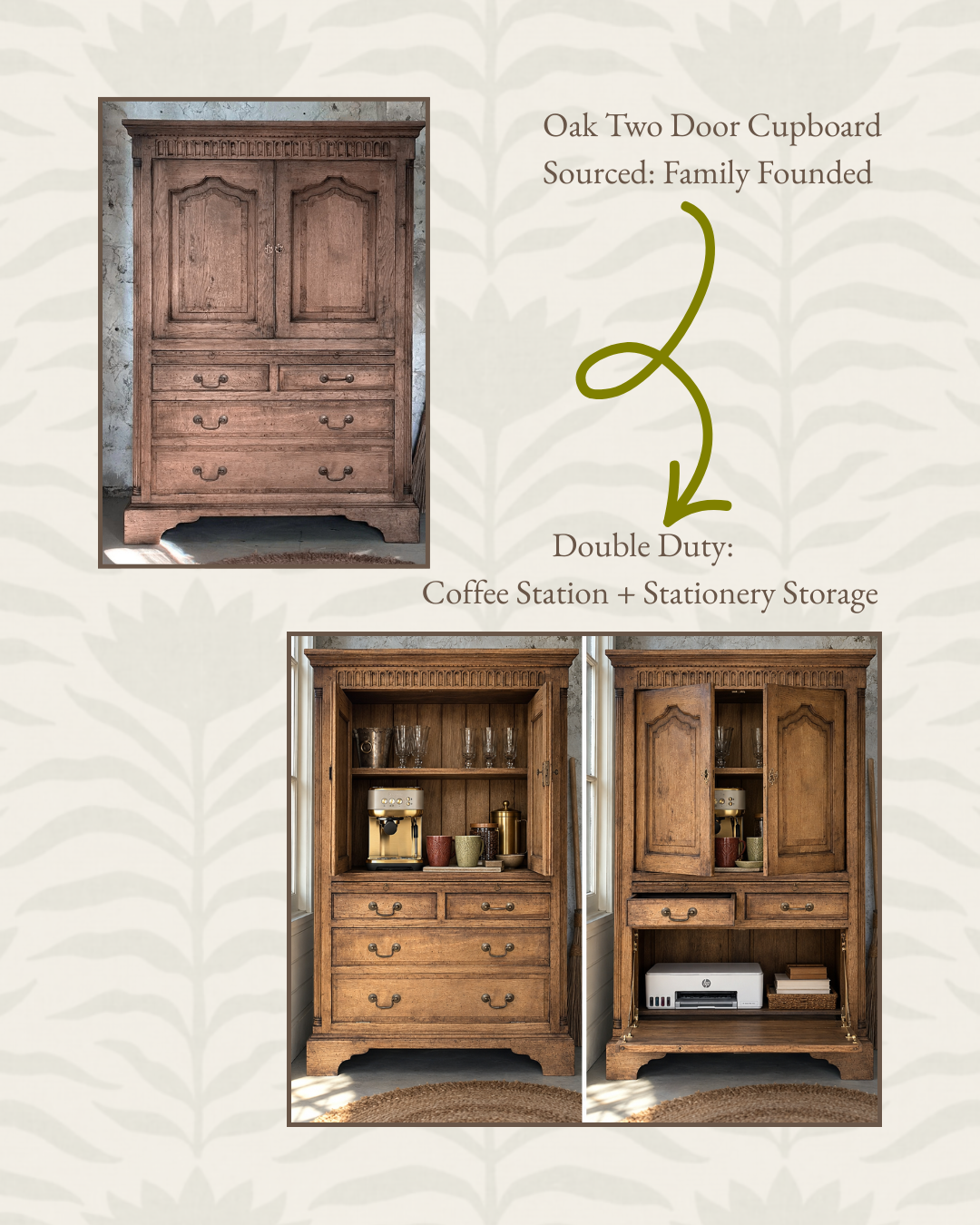
A repurposed oak cabinet can bring far more character to a home office than a matching furniture suite. This two-door oak cupboard from Family Founded, doing double duty. Coffee station above, printer and stationery below, all behind closed doors. No more eyesore.
Look at what you already own, too. That beautiful piece in the hallway may suit your office better. If you rent, a hero piece goes wherever you go, which makes it a good place to put your personality and your budget.
Then add the small layers. A favourite artwork above the desk. A ceramic cup holding pens. A lamp casting a warm pool of light. Books you return to for inspiration. A small object from your travels, sitting beside the computer.
Individually they look insignificant. Together they create atmosphere.
Think about the end of the working day as well. Can the paperwork be tucked away? Could a decorative cabinet hide the printer, demonstrated in the image above. Would a tray corral the small things that spread across the desk? Leave a little breathing room on every surface so the pieces you chose can be seen.
The point is to enjoy the room, with less time spent rearranging accessories.
Your Inspiring Home Office Checklist
The foundation
☐ How will I use this space across a typical working day?
☐ Have I measured the room and identified my storage needs?
The hero piece
☐ Have I chosen one piece that gives the room its personality?
☐ Could something I already own become the hero?
Colour and texture
☐ Have I drawn my palette from the hero piece?
☐ Am I mixing materials and textures?
Comfort and function
☐ Are my desk and chair right for the work I do?
☐ Have I considered natural light, task lighting and screen glare?
☐ Are power points, cables and equipment accounted for?
Personality
☐ Have I included artwork or objects with personal meaning?
☐ Is there somewhere to conceal everyday clutter?
And the most important question:
☐ Is this somewhere I’d look forward to spending time?
A home office with a point of view
Some rooms call for rich colour, vintage furniture and layered textiles. Others suit a beautifully made timber desk and a handful of meaningful objects. There is room for both. What matters is that the space reflects the person who uses it.
If you’re looking around your home office thinking, I have some lovely pieces, but I can’t quite make them work together, you’re in good company. Often what’s missing is a clear design direction: knowing what to keep, what to introduce and how to bring it all together.
That is exactly the challenge I love solving. Through my interior design services, together we’ll bring your existing pieces, new finds, colour, furniture and layout together into a room that feels genuinely yours.
Your working day deserves a room with a little more personality, don’t you agree?
Explore my services here.