

How to Bring a Place Home Without Turning It Into a Theme
There’s a particular kind of disappointment that happens when a room is technically beautiful, full of things you chose carefully, and yet somehow feels like it is trying a little too hard to be somewhere else.
The colours are right. The objects are recognisable. The references are obvious.
And still, something feels off.
Usually, it’s because the room has copied the surface of a place without understanding what made that place memorable in the first place.
You may have loved the worn stone of a courtyard in southern Spain. The shadows falling across a tiled floor in Lisbon. The richness of handwoven textiles in Central America. The faded colour of an old building in Marrakech. The openness of a coastal house in Greece.
But what stayed with you was probably not the object itself.
It was the feeling around it.
The warmth of the light. The irregularity of the materials. The sense that things had been touched, used, repaired and lived with. The quiet contrast between rough and refined. The way one colour appeared again and again without ever feeling matched.
That is what needs to come home with you.
Not the whole destination.

A Living Room With “Global” Layering: Artwork that reminds the owner of their travels overseas, of visits to a local market to shop for native fruits and nibbles for a picnic in the park.
Artwork credit: brittanyferns.com
Start with the memory, not the label
When someone says, “I want my home to feel Mediterranean,” that is useful. But it is only the beginning.
The word is a doorway.
Behind it, there is usually something much more specific.
Perhaps it is the chalky softness of limewashed walls. Perhaps it is the contrast between a heavy timber table and a simple linen curtain moving in the breeze. Perhaps it is the way terracotta warms underfoot, or the quiet repetition of arched forms.
The label helps us locate the memory. It should not become the decorating instructions.
This matters because broad style labels tend to flatten places that are anything but broad. Spain is not Greece. Morocco is not Portugal. Costa Rica is not southern Italy. Even within one country, the landscape, materials, architecture and light can shift dramatically from one region to another.
A meaningful room does not need to reproduce a destination accurately.
It needs to translate what stayed with you.
That translation might happen through colour. Or shape. Or material. Or the way a room is arranged to encourage people to linger.
The strongest travel-influenced interiors are often the least literal.
They do not announce where they came from.
They simply carry the memory well.
Ask what you actually responded to
Before buying anything, it helps to separate the place from the feeling.
Look back at the spaces you remember most clearly and pay attention to what has stayed with you. Was it the way the light moved across the room? The repetition of a particular material? The sense of enclosure, openness, age or ease? Perhaps it was the contrast between rough walls and smooth ceramics, or the way furniture was arranged for conversation rather than display.
Often, what we remember most vividly is not a specific object at all. It is the atmosphere around it.
You may realise you were never drawn to a country’s “look” in the first place. You were responding to the depth created by patina, the irregularity of handmade materials, the warmth of worn timber, or the feeling that every element had found its place slowly rather than arriving in one coordinated delivery.
That is the useful information.
Because once you understand what moved you, you can bring that feeling into your own home without filling it with replicas. The destination becomes a reference point rather than a decorating formula, and the room has space to feel personal, grounded and entirely its own.

Tactile Materials Reminiscent of Place and Time: A timeworn timber coffee table, woven natural fibres underfoot, and the aged metal of the brass monkey all bring texture and patina that is suggestive of time spent abroad rather than a recognisable and specific geographical style.
Translate the place through materials
Materials hold memory better than motifs.
A patterned cushion may hint at a destination, but the weight of a material can carry much more.
Think of the coolness of stone under bare feet. The softness of washed linen. The uneven surface of a hand-cut tile. The dull glow of aged brass. The grain of timber that has darkened over time.
These details create atmosphere without resorting to imitation.
They also allow the room to remain connected to its actual location.
A Melbourne home does not need to deny Melbourne in order to carry the feeling of somewhere else. In fact, the more successfully the two are held together, the more personal the result becomes.
The aim is not to recreate a villa, riad, finca or island house.
It is to understand which materials created the feeling you loved, then reinterpret them in a way that belongs to your own architecture, climate and way of living.
That may mean choosing a hand-finished wall rather than a themed wallpaper. A beautifully made timber piece rather than a collection of decorative souvenirs. One tactile textile rather than a room full of competing patterns.
Small decisions. Held with conviction.
Let colour behave as it did in the memory
Colour is another place where people can become too literal.
A coastal holiday does not automatically require blue. A trip through Mexico does not mean every surface needs to be saturated. A love of Morocco does not demand jewel tones.
Often, the most powerful colour memory is quieter.
The dusty pink of a faded wall at dusk. The green of old shutters. The muted ochre of stone. The deep brown of timber against pale plaster. The chalky white of a building warmed by late-afternoon sun.
These colours are powerful because they belong to a wider atmosphere.
They are affected by light, scale, age and material.
When bringing them into a home, they need the same context.
One strong colour used with restraint often carries more feeling than a whole palette of obvious references. It can appear in a painted cabinet, a piece of artwork, a rug, a ceramic vessel or a single upholstered chair.
The point is not to prove the inspiration.
The point is to let the room absorb it.
Choose one object with a real story
Travel memories become more compelling when they are anchored by something specific.
Not twenty things.
One.
A ceramic bought directly from the person who made it. A textile found in a market. A small carved object. A photograph. A piece of art. A bowl that sat on the table of a house you stayed in. An old timber stool that somehow made it home.
The object does not need to be expensive.
It needs to mean something.
This is where a room begins to feel collected rather than styled.
The piece gives the rest of the room a point of reference. Other choices can respond to its colour, shape, material or mood without copying it.
A single object with genuine history will always carry more presence than a shelf filled with items bought later to “complete the look.”
That is the difference between memory and merchandising.
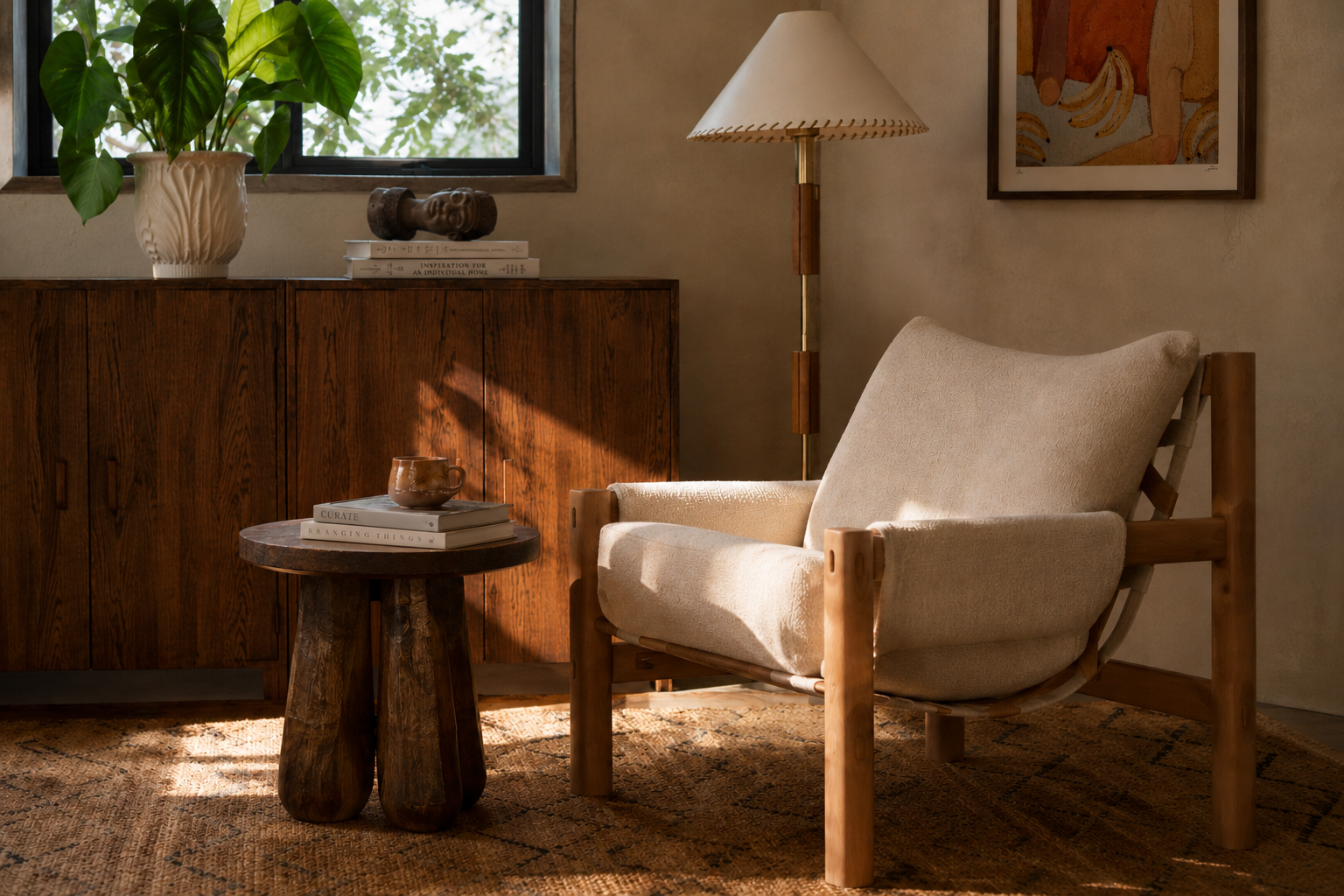
A Meaningful Object That Other Materials Respond To: A handcrafted soapstone statue speaks to the vintage carved stool, the original artwork and woven textile continue the dialogue, while the chair and floor lamp sit quietly and nod. What results is an intelligent and respectful conversation between objects - not everyone shouting at once, not one soul being ignored.
Avoid buying the costume
The fastest way to turn a travel memory into a theme is to buy all the most recognisable symbols at once.
The patterned rug. The lantern. The carved screen. The printed cushions. The decorative tiles. The replica pottery.
Each item may be beautiful on its own.
Together, they can start to feel like a costume.
A room loses depth when every choice is trying to make the same point.
It also becomes difficult for your own history to enter the picture.
Your existing furniture, your books, your art, your family pieces and the architecture of the house should still have a voice. The travel reference is a layer, not the entire identity of the room.
This is where editing matters.
You may need only one patterned textile, not five. One aged brass detail, not a collection. One strong ceramic form, not a shelf of matching pieces.
Restraint here does not mean making the room polite.
It means allowing the right things to speak.
Let your own home answer back
A place-inspired room should still feel grounded in the home it belongs to.
The proportions matter. The quality of light matters. The height of the ceilings matters. The age of the building matters. The way you actually live matters most of all.
A small apartment in St Kilda will respond differently to an idea than a sprawling country house. A Victorian terrace may already carry enough decorative detail and need a quieter hand. A modern rental may need warmth, texture and stronger furniture placement before it needs anything decorative.
This is why copying a room from somewhere else rarely works.
The reference may be beautiful, but your home has its own conditions.
Good design listens to both.
It holds the memory of one place while respecting the reality of another.
That tension is where the interesting decisions live.
Bring back the way people lived, not just what the room looked like
Sometimes what we miss most about a place has very little to do with decoration.
We miss the long lunches. The open doors. The chairs pulled close together. The way people gathered in the kitchen. The evening light. The sense that nobody was in a hurry to leave.
Those memories can be translated too.
Your dining table may need to be larger, the seating a little less formal, or the lighting more inviting after dark. It might be as simple as adding a side table within easy reach, so conversation can continue without interruption and nobody is left juggling a glass.
A room can carry the spirit of a place through hospitality.
In many cases, that is far more powerful than colour or pattern.
It also lasts longer.
A decorative reference may fade from view. The way a room makes people feel tends to stay.

Arranged for Conversation and Life: This is a room designed so family and friends can gather and talk and laugh and trade secrets, a side table within reach to place a wine glass, slippers kicked off, a book marked ready to pick up where they left off. Nothing too precious, eager to host again.
Give the room time
The rooms that feel most deeply connected to travel rarely happen in one shopping trip.
They grow slowly.
A piece is added. Something old moves rooms. A colour is repeated. A material appears again in a different form. The thread becomes clearer over time.
This gradual layering is not a failure to finish.
It is often what gives the room its depth.
Places become meaningful through experience, repetition and memory. Homes do too.
You do not need to return from a trip and redesign everything before the suitcase is unpacked.
Begin with what stayed with you.
One material. One object. One colour. One shift in how the room is used.
Then let the home answer.
Bring the feeling home
Travel can change the way we see colour, material, light and space.
It can make us braver. More observant. Less interested in things that feel mass-produced or overly resolved.
But the goal is not to make your home resemble somewhere else.
It is to understand what that place showed you about how you want to live.
That is the part worth keeping.
The texture. The warmth. The irregularity. The way people gathered. The object that still makes you smile. The memory of light moving across a wall.
Bring those things home. Leave the theme behind.

The Passport Plan - One room. Complete clarity: For rooms that need more than a styling pass. We lock in a cohesive concept, improve flow, and curate the key pieces so everything works together — without endless options or second-guessing.
If you have collected pieces, references and memories but cannot yet see the thread that will hold them together, The Passport Plan is designed to help you shape one room with clarity. We will translate what you love into a considered direction that belongs to your home, rather than recreating somewhere else.
Explore The Passport Plan and begin with the room you are ready to reimagine.