

The brief isn't the room. It's the life the room has to hold.

Hello New YOU!
A warm lived-in interior — afternoon light, linen, texture, patina, and aged timber. add artwork and greenery and you suddenly have a living room that welcomes your loved ones while showing them who you are today.
The boxes were open, but not unpacked.
A linen shirt hung over the back of a dining chair. Two framed photographs leaned against the wall because deciding where they belonged felt strangely permanent. On the floor sat a ceramic bowl carried home years ago, wrapped in newspaper from another country — beside a lamp bought quickly because the room needed light.
Outside, Melbourne was moving through an ordinary afternoon.
Inside, the room looked perfectly serviceable. Pleasant, even. Yet standing in the middle of it brought the uneasy feeling that the space had been arranged for somebody else.
Not a stranger, exactly.
An earlier version of you.
Perhaps the room still carried the compromises of a marriage that had ended. Perhaps you had returned from years overseas with a richer sense of colour, texture and atmosphere, only to find that your Australian home looked curiously polite. Maybe the children had left, and rooms that once worked hard now sat waiting for a purpose. Or a sea-change had given you the address you wanted without showing you how to make the house feel like your life.
These moments are often described as decorating problems.
They rarely are.
A new sofa may fill the empty wall. It won't answer the larger question humming underneath: what belongs here now?
When a room belongs to an earlier chapter
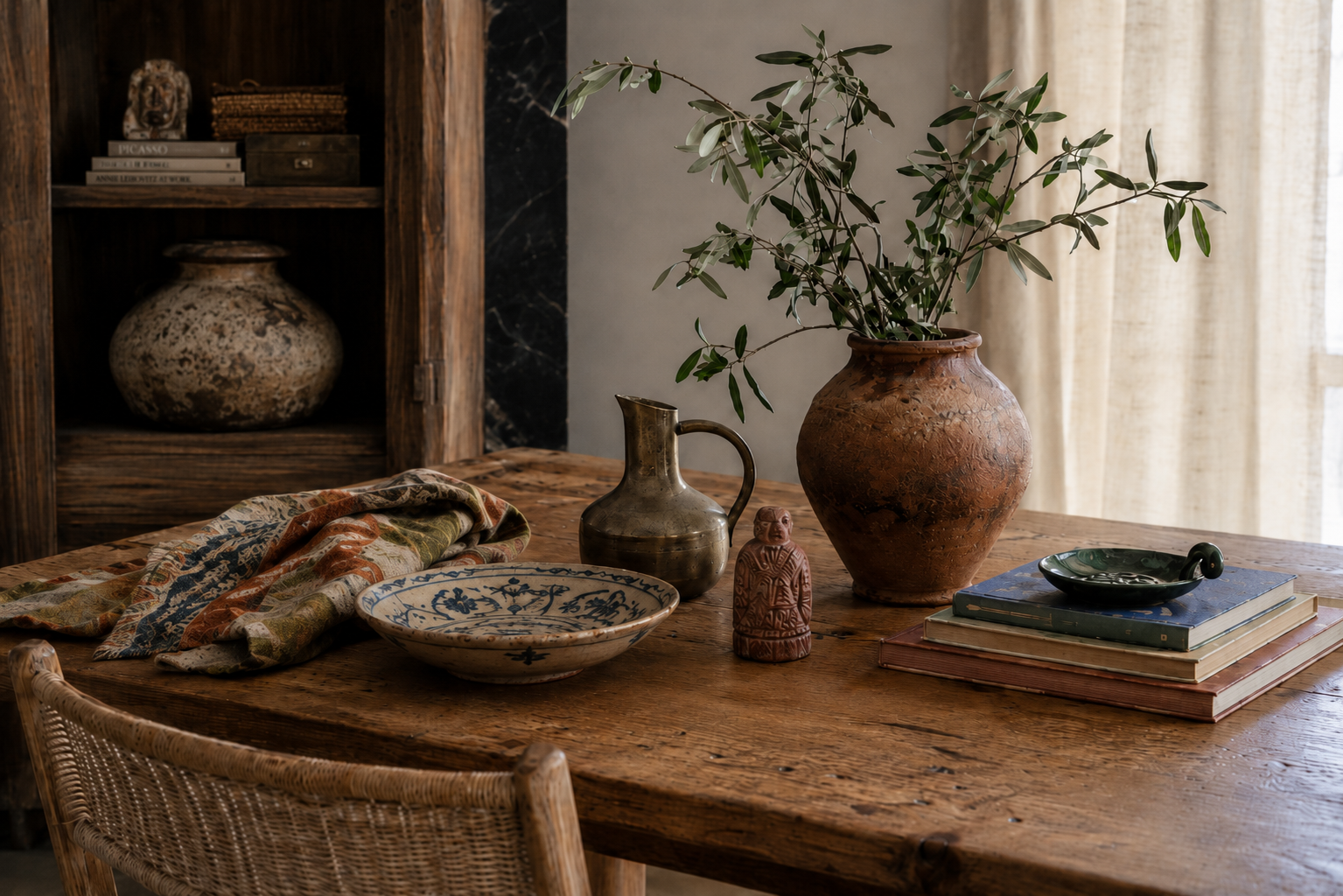
Collected with Care
Objects hold meaning. A Ceramic jug picked up while exploring a laneway in Seville. A hand-painted bowl carried home in hand luggage from Lisbon. Books lovingly curated through years of scouring local bookshops.
Homes are remarkably good at keeping records.
The dining table chosen when every decision needed to suit five people. The cabinet inherited during a year when saying no felt impossible. The neutral rug bought because it offended no one. Shelves crowded with objects genuinely loved, yet somehow the room still feels as though it has lost the plot.
Nothing is necessarily wrong with the individual pieces.
That is what makes the feeling difficult to name.
You may have good taste. You may know precisely which hotel lobby, Spanish courtyard or beautifully worn European apartment made you stop and look twice. You may have collected textiles, ceramics, books and small treasures across decades. Yet back at home, those references sit beside one another without a clear thread.
Collected can begin to feel chaotic.
Or worse — the meaningful pieces disappear inside a room that is simply too cautious to hold them.
For someone beginning again after divorce or separation, the problem often takes another form. The house may be full of things that remain useful, familiar, or loved, while still speaking too loudly of a life that no longer exists in the same way.
There is no need to erase it.
But there does need to be room for who you are now.
That may mean keeping the long dining table because it still hosts the people who matter. It may mean moving the artwork that has always been treated as secondary into the place of honour. It may mean acknowledging that the bedroom shaped by years of compromise now feels like a hotel room booked under the wrong name.
Small decisions carry more emotional weight after a life change. That does not make you indecisive. It means the decisions are no longer only about furniture.
They are about recognition.
Why the brief has to begin before the furniture
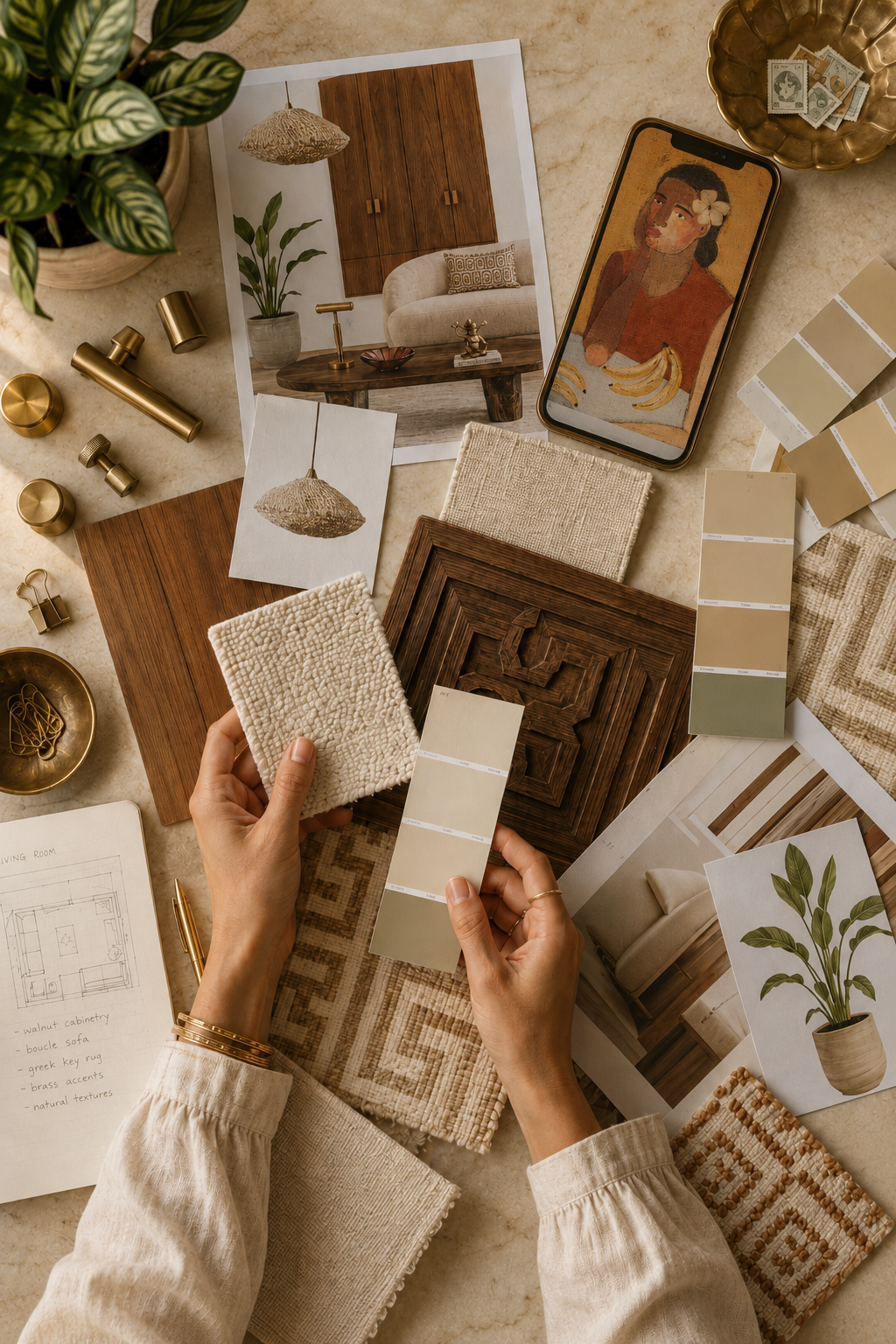
Thinking in Progress - A New Beginning.
It starts with your story, what still serves you well, what needs to be left behind, and how we can best reflect this new chapter without slamming the cover shut on your old book of life and belongings.
This is why a useful brief cannot start with a shopping list.
"New sofa, rug, lighting, occasional chair" tells me what might enter the room. It says very little about what the room needs to do for the person living there.
A brief that actually works goes further.
It asks what has changed. It asks which parts of your previous life still belong, and which are taking up space through habit rather than affection. It notices whether you want to host again but keep finding reasons not to. It considers the objects brought home from elsewhere, the pieces you have quietly outgrown, and the practical realities that will not disappear because a fabric book has been opened.
It also asks how you want to feel when you walk through the door.
Not in vague design language. In real terms.
Do you want the room to feel generous enough for long dinners again? Do you want somewhere to sit in the morning that catches the light? Do you want your home to carry the cultural references and material richness that shaped you overseas — without turning travel into a theme? Do you need a space that feels distinctly yours after years of shared decisions?
That is the work before the furniture.
Good design begins long before the cushions and the coffee table.
You do not need a blank slate

Things Give Us The Feels and That’s OK
I won’t ever tell you to throw all your things away and start from scratch. We’ll assess what you still love and how we can incorporate them into your new Studio Halo & Fitz design.
There is a temptation, particularly after separation or a significant move, to believe that beginning again means replacing everything.
Sometimes that impulse is less about the objects than the relief of making a clean decision.
But a home with depth is rarely built by removing every trace of what came before. It grows through editing: noticing what still has energy, what carries a memory worth keeping, and what has quietly become an obligation rather than a choice.
The bowl brought back from Spain may still be exactly right.
The sideboard selected for a house three addresses ago may need a different role. The armchair may be worth reupholstering rather than replacing. The collection of framed works may not need reducing — it may need hierarchy, spacing and one confident wall colour behind it.
You do not need to start again.
You may need a stronger thread.
For the person returning to Melbourne after years abroad, that thread might be found in sun-washed colour, aged timber, hand-worked ceramics and fabrics with visible texture — not because the room needs to recreate another country, but because those materials carry qualities that now feel like home.
For someone moving forward after divorce, the thread may begin with one choice made without negotiation: the deep olive walls, the sculptural lamp, the dining room that finally feels ready to receive people.
For an empty nester, it might mean allowing the formal living room to become somewhere genuinely used — books open, music playing, feet on the ottoman.
For a sea-changer, it may mean resisting the predictable coastal catalogue and designing around the actual rhythm of the new life: wet towels, visiting friends, afternoon light and the treasured pieces that made the journey.
The room does not need a costume.
It needs a point of view.
What the Align + Define call is for
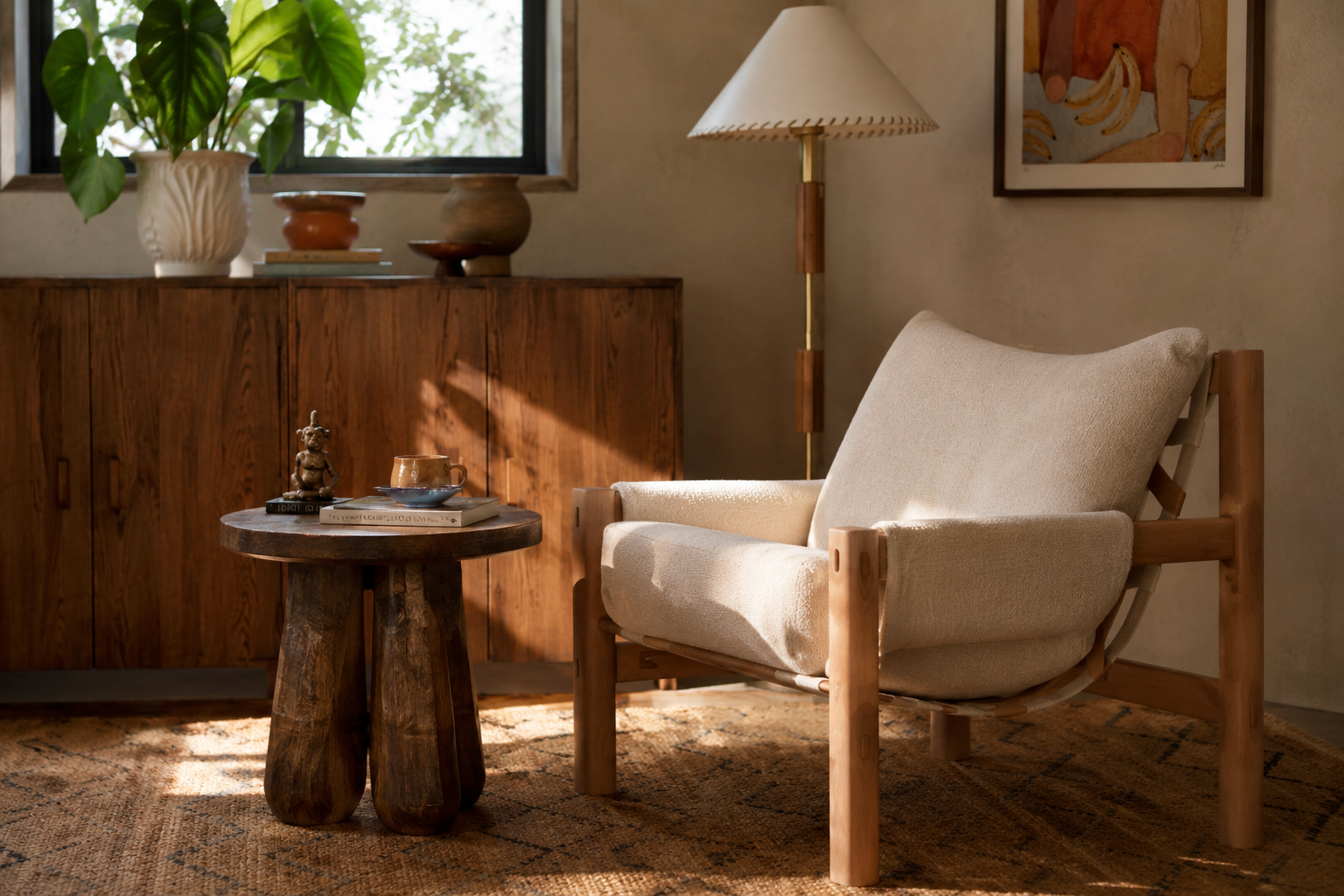
Small Shift. Big Mood.
Take a seat, stay a while — a single chair, a small table, good light — we begin with the basics and add layers and dimension from there.
You do not need to arrive with a polished brief.
You may know the room feels wrong without yet knowing whether the answer is a focused edit, a complete room plan or support across several spaces. You may have pieces you want to keep, a life that has shifted, and decisions competing for your attention.
That is enough to begin.
The free 20-minute Align + Define call is a practical first step. We talk through the basics of your project — the rooms involved, what has changed, what feels most pressing, and what kind of support you might need.
It is not the full design brief. Its purpose is to give the project an initial shape and identify the right next step.
That might be an E-Design package for one room or several. It might be The Grand Tour for a more involved, whole-home project. Or it may become clear that the room needs a smaller, more focused intervention than you first thought.
For E-Design clients, the deeper exploration happens in the Project Kickoff Call — where we look closely at how the room needs to function, what to retain, and how you want it to feel.
For Grand Tour clients, that fuller understanding begins in the paid Discovery Call, where we examine scope, priorities, and the life the home now needs to support.
The Align + Define call simply helps us find the right door.
A room is allowed to move forward with you

The Passport Plan - One room. Complete clarity.
For rooms that need more than a styling pass. We lock in a cohesive concept, improve flow, and curate the key pieces so everything works together — without endless options or second-guessing.
A house can hold memory without keeping you stuck.
It can carry the countries you have lived in, the people you have loved, the family life that once filled every corner, and the decisions you are now ready to make differently.
The aim is not a room that announces change.
It is a room that no longer argues with it.
One where the objects that mean something are given space to speak. Where the layout supports the way you actually live today. Where colour, texture and material have enough conviction to reflect a point of view shaped by experience — not inherited by default.
Where you walk in and recognise yourself.
That is the brief.
If your home belongs to an earlier chapter, you do not need to have the whole answer before making contact.
Book a free Align + Define call and we will find the right place to begin.